2027 BS in Business Administration for Growing Founder-Led Companies: Which Business Courses Should You Prioritize?
Audited and Verified:
Our Editorial and Data Verification Process
Research.com uses government datasets, official education statistics and primary institutional information to support its career and degree guides. Our review process checks factual accuracy, occupational definitions, source dates and the requirements associated with the credentials discussed.
How This Article Was Fact-Checked
Our editorial team verifies salary estimates, employment projections, education requirements and program information against original data providers and official organizations. Salary figures are checked against the relevant occupational definitions and reporting periods. Information about licensure, accreditation and required in-person training is reviewed separately.
Fact-checked and verified on:

Co-Founder and Chief Data Scientist
A founder-led company can outgrow the informal decisions that helped it get started. Pricing, cash flow, hiring, and delivery become harder to manage as customers and staff increase. For founders and early employees considering a BS in Business Administration, the useful question is not whether business courses sound relevant - it is which courses address the company's next constraint.
This guide ranks the most useful subjects, explains what a degree can and cannot provide, and helps you decide whether a full program or targeted training is the better investment.
Key Things You Should Know
- Prioritize managerial accounting and finance when cash or margins are unclear; choose operations, marketing, or people-management courses when those functions are the binding constraint.
- Look for assignments that test decisions with appropriate data. A classroom forecast is useful practice, not proof that a growth plan will succeed.
- A bachelor's degree commonly takes about four academic years of full-time study from the start; founders with prior credits should obtain an official degree audit before estimating their remaining time or cost.
What is a BS in Business Administration for Founder-Led Companies?
A BS in Business Administration is an undergraduate degree covering several business functions rather than training for one founder role. A founder-led company is one in which the founder still substantially shapes strategy or daily decisions. As the company grows, the degree's potential value is a framework for delegating and evaluating decisions across finance, customers, operations, and people.
It is not a special credential for entrepreneurs, and its name does not establish a standard curriculum. A BBA or BA in Business may cover similar ground; a specialized accounting or supply-chain degree may go deeper in one function. Compare actual course requirements and applied assignments when considering ranked school options for studying business online, rather than assuming the degree title determines founder usefulness.
Which business courses best prepare founders to grow a company?
Start with managerial accounting, finance, and operations; then prioritize marketing analytics or people management according to the company's constraint. The best course is the one that improves a decision the founder must make repeatedly - not necessarily the course labeled "entrepreneurship."
The comparison below connects common course subjects to decisions in a growing company. It describes what coursework can help a student analyze, not results a class can produce for a business.
| Course priority | Growth decision it supports | Useful academic practice |
| Managerial accounting and finance | Whether pricing, costs, and cash can support expansion | Contribution-margin, budget, and cash-flow analysis |
| Operations and process management | How to deliver consistently without relying on the founder for every exception | Process maps, capacity estimates, and quality measures |
| Marketing research and analytics | Which customers to pursue and how to assess acquisition efforts | Customer segmentation and campaign-measurement plans |
| Organizational behavior and HR | How to define roles, supervise fairly, and develop staff | Role design, feedback scenarios, and staffing plans |
| Strategy and entrepreneurship | Which growth opportunities justify limited resources | Assumption-based comparisons of options and risks |
Sequence matters. Financial accounting and statistics often precede more advanced finance or analytics courses, so check prerequisites before selecting electives. If the immediate problem is coordinating complex client work, project management may deserve priority over a broad entrepreneurship elective. Founders whose goal is primarily project delivery can also compare online project management degrees with lower tuition with the business degree's wider functional coverage.
For an applied assignment, use a clearly labeled hypothetical case or obtain permission to use company information. Revenue is not profit, and a profitable forecast does not establish that the company will have enough cash to execute it.
How can business students choose an accredited degree program?
First, confirm that the institution holds recognized institutional accreditation and that the advertised BS is the degree actually awarded. Then examine the curriculum for accounting, operations, and customer analysis - not just the number of entrepreneurship electives. AACSB, ACBSP, and IACBE accreditation can provide additional business-program context, but check each accreditor's stated scope to see whether it covers the relevant school or program. Accreditation alone does not establish graduate business outcomes.
Ask an adviser for the current catalog, a sample course sequence, rules for workplace-based assignments, and an official transfer evaluation if applicable. When reviewing ranked US colleges for faster business degree completion, verify required-course availability: an advertised fast pace will not help if a prerequisite is offered too late for your schedule.
Most programs combine general education with a business core that may include accounting, economics, finance, marketing, management, business law, statistics, information systems, and strategy. Requirements differ by institution. For a growing company, the value of the core is learning how decisions interact: a sales target affects staffing, capacity, working capital, and customer experience.
Electives or a formal concentration can add depth, but they are not interchangeable. An operations elective does not create an operations concentration unless the school awards one. A capstone may integrate several subjects, while an internship or approved workplace project has separate eligibility and supervision rules. Founders whose main development need is supervising a larger team may also compare completion times for organizational leadership degrees; they should still check whether those programs offer enough finance and operations coursework for their goals.
An online program may reduce travel and let a founder study around operating hours. It is not necessarily self-paced: live sessions, fixed deadlines, group presentations, proctored exams, or an on-site requirement can conflict with customer and staffing demands. Campus study may offer easier in-person collaboration and local connections but can require a less flexible weekly schedule.
Request a recent syllabus for a required quantitative course and a capstone before enrolling. Check live-attendance rules, group-work timing, leave policies, and whether the company can be used as a project setting with faculty approval. Founders considering fast-paced online business degrees should distinguish a shorter calendar from a lighter workload; acceleration may compress the same work into fewer weeks.
Requirements depend on the school and whether an applicant is entering as a first-year or transfer student. Schools commonly request prior academic transcripts; some business majors have separate entry requirements or prerequisite courses. A founder's operating experience can strengthen an application, but it does not automatically replace algebra, accounting, or other required coursework or award degree credit.
Ask admissions which documents are required, then ask an academic adviser how previous courses would apply to general education, the business core, and electives. If application expenses matter while comparing programs, application-cost-free online school options may widen the initial search; confirm each school's current fee policy and program requirements before applying.
A bachelor's degree typically spans about four academic years of full-time study from entry, but a founder's completion timeline depends on applicable prior credits, course sequencing, and study pace. There is no reliable universal price for a BS in Business Administration. Tuition may be charged by credit or term, and the amount advertised may omit fees and other expenses.
Before comparing offers, request a degree audit and an itemized estimate for the courses still required. Include books, software, travel or proctoring charges, borrowing costs, and the value of time diverted from the company. A lower per-credit rate is not necessarily cheaper if more credits remain. Use options to reduce tuition costs for a business degree as a starting point, then confirm current charges and financial-aid eligibility directly with each school.
Some graduates remain founders and use the degree to improve decisions rather than change jobs. Others may pursue operations coordinator, marketing coordinator, project coordinator, or HR-support roles in growing firms. These jobs can involve tracking work, preparing reports, coordinating vendors or campaigns, and communicating across a small team. A degree can support that work, but employers also look for evidence of execution; a management title usually requires demonstrated responsibility beyond coursework.
A founder or employee building a portfolio should describe the decision, assumptions, analysis, and limits of a permitted project - not claim an unverified improvement in sales or efficiency. For someone aiming specifically at project coordination, it may be worth examining how to use prior college credits in a project management bachelor's before choosing between that focused path and a broader business degree. The receiving school decides which credits satisfy its requirements.
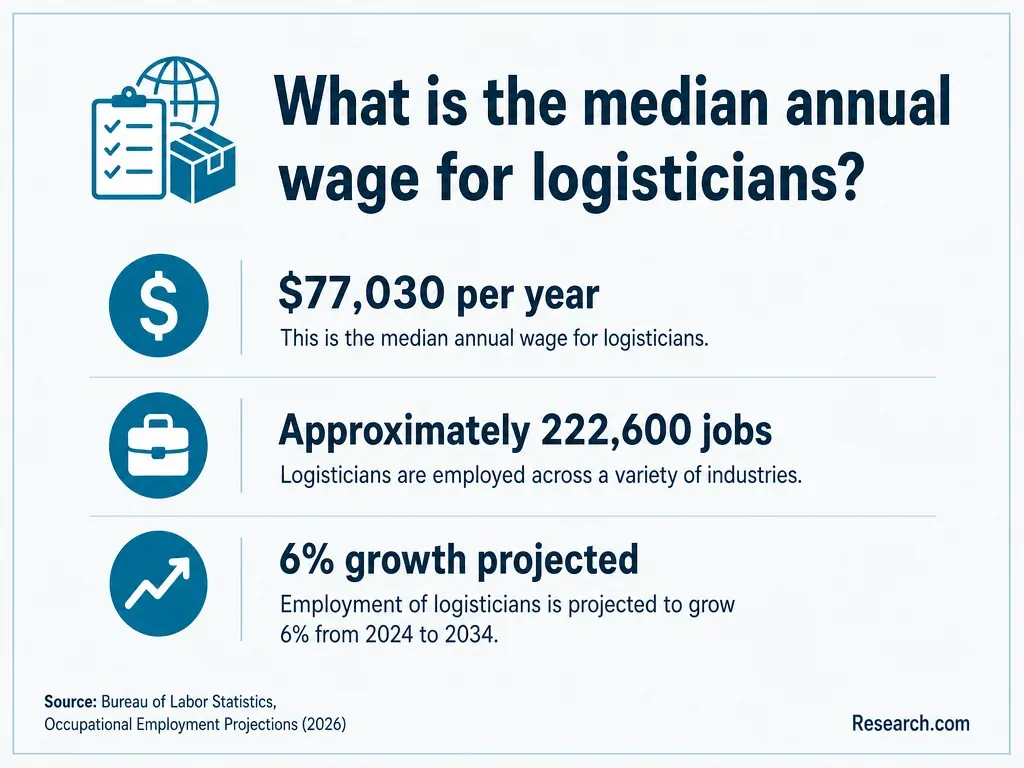
There is no single salary for BS in Business Administration graduates, and founder compensation depends on the company's finances. As one occupation-specific reference, the U.S. Bureau of Labor Statistics reports a $78,760 median annual wage for market research analysts in May 2025. That is an occupation-wide median, not an entry-level offer or a predicted return on a business degree. Location, employer, duties, and experience affect individual pay.
Founders evaluating education as a financial investment should compare its total cost and time commitment with the decisions they expect to improve - not assume a wage increase. For additional business administration program length and salary context, keep program claims separate from occupation-level wage statistics and request any school-reported outcomes with their cohort definitions.
Which certifications and skills complement a business administration degree?
Spreadsheet modeling, financial-statement interpretation, clear writing, customer research, and process mapping are immediately useful complements. Choose a certification only when it matches a recurring responsibility and its eligibility rules. Project management, HR, accounting, and financial-services credentials have distinct requirements; a business degree or one related course does not automatically qualify someone for them.
If project work is becoming a substantial career function, compare the credential's experience requirements and exam costs with the depth of further study. A founder considering another undergraduate degree instead of targeted training can consult project management undergraduate scholarship comparisons, while verifying eligibility and total remaining cost. If the immediate need is a better budget or a repeatable hiring process, a focused course, experienced mentor, or supervised workplace project may be more useful than another credential.
Other Things You Should Know About Business Administration
Possibly, but check the instructor's requirements and your obligations to customers, employees, and business partners first. Remove or protect sensitive information; use a hypothetical case if permissions are unclear.
There is no universal degree requirement for seeking investment. Investors may assess the company's evidence, risks, team, and execution; coursework can help a founder prepare, but it does not substitute for those factors.
Yes, if the work relies on lawfully available information and follows the assignment's rules. Identify assumptions and avoid presenting estimates as access to the competitor's internal results.
Postponement may be sensible during a cash shortage, major launch, or staffing transition if required study hours would jeopardize operations. Address the urgent skill gap with targeted learning, then revisit the degree when its broader benefits justify the commitment.
- AACSB Accreditation: The Gold Standard or Fool's Gold | valpo.edu https://scholar.valpo.edu/cgi/viewcontent.cgi
- Understanding and managing organizational behavior | Lynn University https://online.lynn.edu/resources/business/understanding-managing-organizational-behavior
- Traditional and Digital Marketing Courses at Harvard https://professional.dce.harvard.edu/marketing-programs/
- Organizational scaling, scalability, and scale-up | sciencedirect.com https://www.sciencedirect.com/science/article/pii/S0883902624000417
- HR's Strategic Role in Organizational Culture Change | Florida Tech https://online.fit.edu/degrees/undergraduate/ba-hr-management/organizational-culture-change/
- AACSB Global Standards for Business Education https://www.aacsb.edu/educators/global-standards
- Finance and Accounting for Non-financial Executives | Foster School of Business https://foster.uw.edu/executive-edu/topic-focused-courses/finance-and-accounting-for-non-financial-executives/
- Finance and Accounting Online Course at Columbia Business School Executive Education https://online1.gsb.columbia.edu/finance-accounting-nonfinancial-professional
- Startup Finance and Strategy | Babson College https://www.babson.edu/professional/individuals/finance/startup-finance-and-strategy/
- 8 things to consider when searching for an MBA program | FIU College of Business https://business.fiu.edu/academics/graduate/insights/posts/8-things-to-consider-when-searching-for-an-mba-program.html