# 1 position

Audited and Verified:
Our Editorial and Data Verification Process
Research.com uses government datasets, official education statistics and primary institutional information to support its career and degree guides. Our review process checks factual accuracy, occupational definitions, source dates and the requirements associated with the credentials discussed.
How This Article Was Fact-Checked
Our editorial team verifies salary estimates, employment projections, education requirements and program information against original data providers and official organizations. Salary figures are checked against the relevant occupational definitions and reporting periods. Information about licensure, accreditation and required in-person training is reviewed separately.
Fact-checked and verified on:

Co-Founder and Chief Data Scientist

Reviewed by Karolina Broda
Fact-Checker and Data Verification
Choosing a business administration associate degree in Montana means deciding whether you need a route into office work, a degree designed for transfer, or both. The stakes are real: the U.S. Bureau of Labor Statistics projects 5.0% national growth for general and operations managers from 2025 to 2035, though that is not an entry-level role. This guide explains degree types, costs, career prospects, and questions to ask schools. It also features the Best Business Administration Associate Degree Programs in Montana for 2027 ranking, created by the Research.com team of data scientists to help students identify programs worth considering.
Expect an introduction to how organizations budget, keep records, market services, supervise work, and make operational decisions. The most important distinction is the degree awarded: an Associate of Arts (AA) or Associate of Science (AS) usually emphasizes transferable general education, while an Associate of Applied Science (AAS) generally puts more space toward occupational coursework. Titles and requirements vary, so judge the published course map rather than the abbreviation alone.
This comparison shows what each route is intended to do. It is especially useful if you might seek office employment now but want to preserve a later transfer option.
| Degree route | Typical emphasis | Best fit and principal check |
| AA | Broad general education alongside business courses | Students prioritizing transfer; confirm how each course applies to the receiving program. |
| AS | General education with potentially more quantitative coursework | Students interested in accounting, analytics, or other quantitative study; confirm the required math sequence. |
| AAS | Business and applied workplace coursework | Students prioritizing near-term office or operations work; check whether any later transfer credits count toward major requirements. |
Montana students can investigate associate-degree options at Miles Community College, Great Falls College Montana State University, Flathead Valley Community College, The University of Montana, and The University of Montana-Western. Do not assume each institution currently offers the same business degree or delivery format: request its current catalog and degree audit. For an AA or AS, ask the prospective receiving institution for a course-by-course evaluation; a transferable course may satisfy an elective rather than a required business course.
Potential starting points include administrative coordination, customer service, bookkeeping support, purchasing assistance, and sales support. In Montana, these functions appear across healthcare organizations, tourism businesses, agriculture-related firms, retailers, and public offices. The practical question is which employers are within commuting distance: a rural student may find fewer openings in one specialty than someone able to search around a larger employment center.
Read local job postings before selecting electives. If nearby employers repeatedly request spreadsheet reporting or accounting software, those skills may matter more than a broadly titled management course. If the work you want is primarily hands-on rather than office-based, consider whether the occupations discussed in what are trade school jobs better describe your goal before committing to a business associate degree.
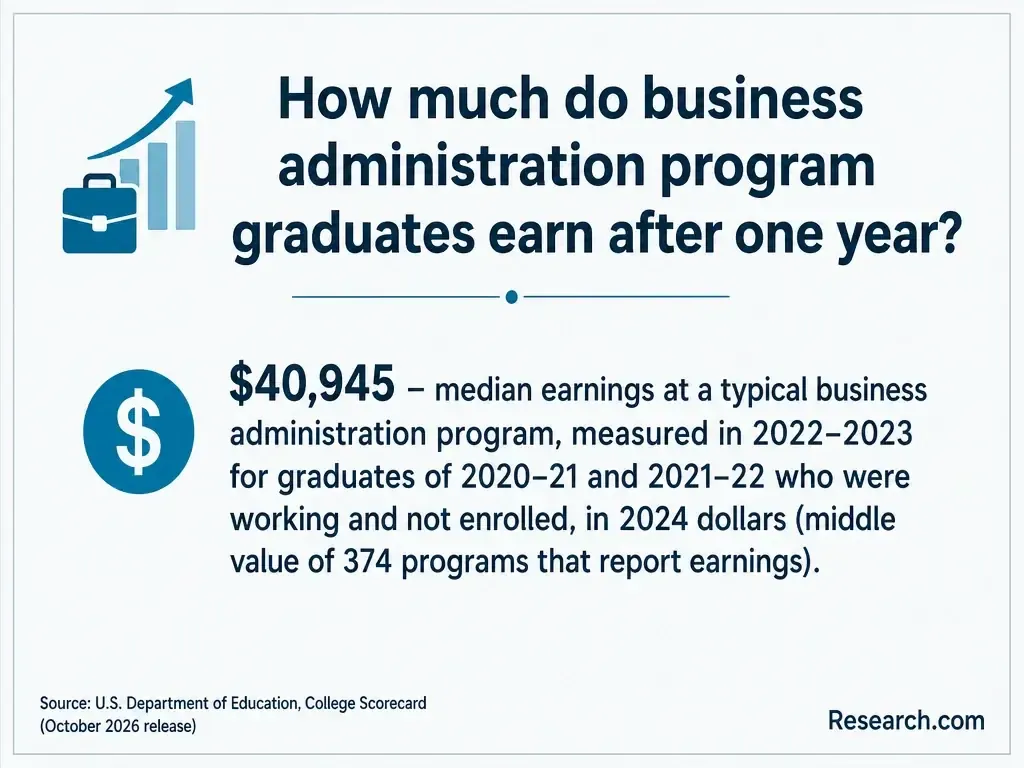
There is no single wage for a business administration associate degree: pay follows the occupation, employer, location, and experience, not the degree title. The U.S. Bureau of Labor Statistics reports a $105,770 national median annual wage in May 2025 for general and operations managers. Many people in that occupation have substantial experience, so using its median to estimate your first job's pay would overstate what the degree alone is likely to deliver.
For a decision-useful estimate, identify two or three entry-level job titles you would actually apply for, then compare current Montana job postings with occupation-specific wage information from the Montana Department of Labor & Industry or BLS. Separate starting offers from published occupational medians. If staying in a rural area limits openings, compare the wages and commuting costs of realistic nearby jobs rather than statewide figures alone.
Many associate degrees are designed around approximately 60 semester credits and two academic years of full-time study, but the catalog - not that rule of thumb - sets your requirements. Part-time enrollment takes longer, and a required accounting or math course offered infrequently can delay completion even when only a few credits remain.
Ask for a term-by-term plan that includes general education, business courses, prerequisites, and any internship or capstone. If you are working, check whether evening or online sections are offered when you need them, not merely whether they have been offered before. Ask the registrar to evaluate prior college credit before estimating either your finish date or your total cost.
Online business courses can make study feasible for people far from a campus or working changing shifts. On-campus courses may make it easier to get scheduled help with accounting, quantitative work, and group projects. Neither format is automatically faster or more transferable; the degree requirements and receiving institution's credit decisions matter more than the classroom location.
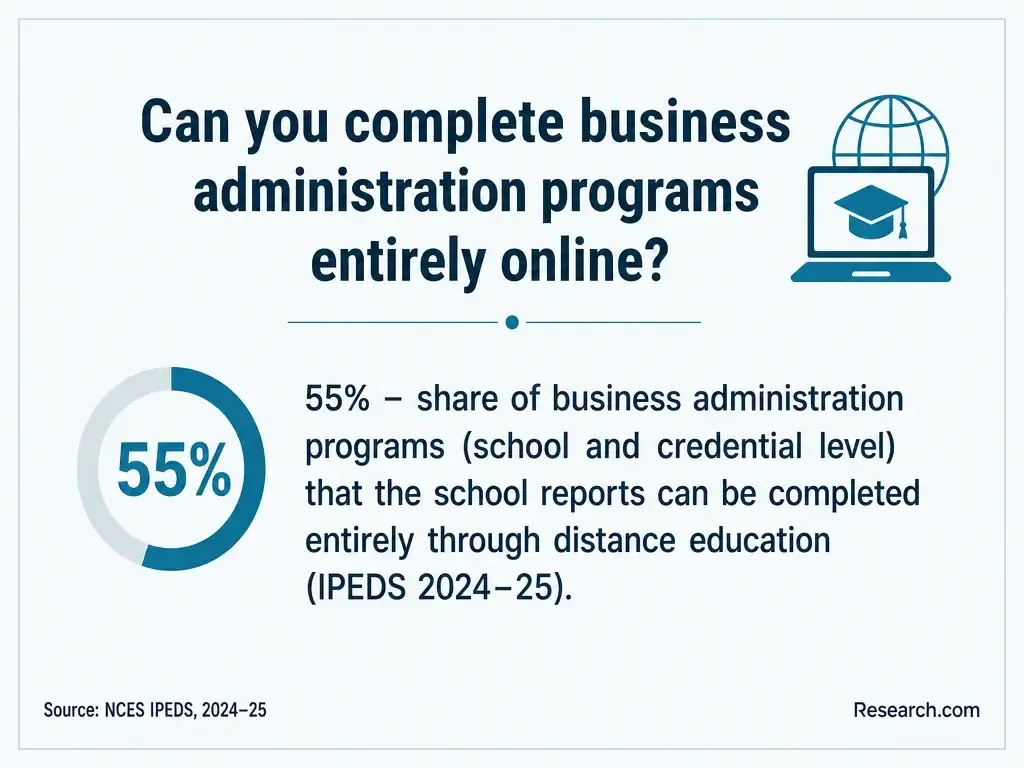
Most lectures, readings, spreadsheets, and written assignments can reasonably be completed remotely if the school offers them that way. A program may still require proctored assessments, scheduled live meetings, an internship, or an in-person capstone. Before choosing a cheap online degree, ask which required courses and activities are available remotely through graduation, what technology you need, and whether local placement is possible for any work-based component.
A single statewide average would be a weak budget for an individual student. Published tuition varies by institution, residency classification, credit load, and year, while the amount you pay also depends on aid and how long you take. Request the current tuition and mandatory-fee schedule from each school and price the whole degree, not just one term.
This breakdown identifies costs that may differ between an inexpensive-looking online option and a nearby campus option. Use your own course plan and aid offer to fill in the amounts.
| Cost component | What to verify |
| Tuition and mandatory fees | Resident eligibility, per-credit charges, online fees, and likely total enrolled terms. |
| Books and technology | Course materials, required software, computer specifications, and internet access. |
| Attendance expenses | Transportation, housing, meals, and any internship travel. |
| Time and financing | Work hours forgone, grants or employer assistance, borrowing, and interest. |
An option marketed as the cheapest associates degree may not be cheapest for you after fees, transfer-credit decisions, and extra terms are included. For a fair comparison, estimate net total cost, expected debt, completion likelihood, time out of work, and the earnings of jobs you could plausibly obtain without or after the degree. Those assumptions - not tuition alone - drive a return-on-investment judgment.
Students at eligible institutions may qualify for federal grants, loans, or work-study after submitting the FAFSA; eligibility and award amounts depend on individual circumstances and program status (Federal Student Aid). Ask each school about its own scholarships, Montana-specific aid for which you qualify, payment deadlines, and whether an employer will reimburse eligible courses. Compare grants and scholarships separately from loans, which must generally be repaid.
Get an aid estimate for the actual terms you plan to attend. Part-time enrollment, taking courses outside your degree plan, or transferring mid-program can change eligibility and the amount left to pay. Before borrowing, ask the financial aid office for a term-by-term net-cost projection that includes mandatory fees and books.
Admission requirements are school-specific. Typically, applicants should expect to provide evidence of secondary-school completion or an accepted equivalent and any required application materials; placement information or prior coursework may determine where they begin in writing and math. A college's general admission decision does not necessarily mean that every required course is open immediately.
Check the current catalog for math and writing prerequisites before setting a completion date, especially if accounting or quantitative business courses depend on them. If you have previous credits, obtain a written evaluation showing which requirements they satisfy. Ask separately about institutional accreditation, which concerns the institution, and state authorization, which concerns its authority to offer education; neither establishes that a particular course will transfer.
Common subjects include composition, mathematics, economics, financial or managerial accounting, management, marketing, business communication, and spreadsheet-based applications. An AA or AS generally reserves more room for general education; an AAS may devote more credits to applied courses. Actual course lists and sequencing must come from the school's current catalog.
Look beyond course titles for assignments that demonstrate workplace ability: preparing a budget, interpreting a financial statement, building a spreadsheet, or presenting a recommendation. Some programs may offer an internship or capstone, but neither should be assumed. If work experience matters to your plan, ask whether it is required, credit-bearing, available near your home, and supported by the college.
Available electives may let students emphasize accounting support, marketing, entrepreneurship, management, or office technology. These are not necessarily named concentrations: confirm that the particular college offers enough relevant courses within the associate degree to make the focus meaningful.
Choose the emphasis backward from your next step. Accounting and spreadsheet courses can support bookkeeping-oriented applications; customer research and communication can support sales or marketing support. If your interests are broader, comparing college majors for the future can help you frame questions about where a transfer-oriented degree might lead, but your immediate decision should rest on this associate program's courses and documented transfer treatment. Optional software or professional certifications can complement those courses; verify their separate exam requirements rather than assuming the degree awards them.
Start with the outcome you need: near-term business employment, a defined transfer route, or both. A ranking can narrow the search, but it cannot tell you whether a required class fits your schedule or whether your intended receiving institution will count it toward the right requirement.
Use the following checks when you speak with admissions, an academic adviser, and - if transfer is your goal - the receiving institution. Ask for written answers you can compare across schools.
Red flags include an unclear degree title, no current course plan, vague claims about transfer, or salary claims built around experienced managers. If immediate employment matters most, favor a curriculum that demonstrably develops the skills in local postings; if transfer matters most, prioritize confirmed course applicability even if another option looks cheaper per credit.
An associate degree can support applications for administrative assistant, customer service, bookkeeping support, sales support, or operations coordinator roles, subject to employer requirements. Responsibilities and titles differ: an "operations" job might be entry-level coordination or experienced supervision. Read duties and required experience, not just the title.
Progression usually depends on demonstrated work: accurate records, software proficiency, customer communication, and the ability to coordinate people or processes. Someone seeking faster proof of a specific software skill can investigate quickest certifications to get that pay well as a complement, while checking whether an employer values the particular certification. Business administration jobs generally do not require an occupational license merely because the applicant holds this degree; specialized occupations can have separate requirements that the degree does not satisfy automatically.
The market is broad but not uniform. The U.S. Bureau of Labor Statistics projects 5.0% national employment growth for general and operations managers over 2025-2035; this indicates demand for that occupation nationally, not the number of Montana openings suitable for new associate degree graduates. Local availability depends on the specific office or support role, employer, and community.
Montana's distances can make the difference between a practical job lead and one that requires relocation or a costly commute. Compare postings in the places where you could actually work, noting pay, required experience, and whether a job can be performed remotely. Employers may value AI-assisted office tools, but the durable test is whether you can verify outputs, protect sensitive information, communicate clearly, and use spreadsheets and business records accurately. Use the degree's projects and any work-based experience to show those abilities rather than assuming the degree title speaks for itself.
Investing in an associate degree is an important decision. Research.com developed the ranking to help readers compare programs against relevant local options, using reported outcomes, costs, and quality indicators rather than a school's name alone. Only programs with completions reported to IPEDS are included; absence from the ranking does not establish that another program is unavailable or poor quality.
Best-program rankings consider student completion and full-time and part-time retention; median earnings one year after completion and earnings relative to annual cost of attendance; tuition, attendance cost, median debt including debt held by students who withdrew, and federal loan default rates; and accreditation, relevant recognition, and student support. Relevant programmatic accreditation or industry recognition receives 20% of the score, institutional accreditation 10%, and student support 10%. The remaining 60% covers outcomes, earnings, and costs, with weights distributed using an entropy-based method that gives more weight to indicators that vary more across programs. An occupation-specific recognition indicator matters only when it is relevant to the program being evaluated.
The research team used the following data sources to check program reporting, institutional information, outcomes, and applicable quality indicators. Some occupation-specific sources in this shared methodology concern fields other than business administration; their inclusion does not imply that a business program needs healthcare or construction accreditation.
These measures make the ranking a starting point, not a substitute for checking the exact degree, current charges, course schedule, and transfer agreement. Institutional earnings or retention figures may not describe business administration majors specifically. More detail about the approach appears on Research.com's methodology page.
# 1 position
# 2 position

# 3 position
Office Management and Supervision
Delivery mode: Online
28.19
/ 100
Final score
Accreditation
Institutional accreditation from Northwest Commission on Colleges and Universities.
Great Falls College Montana State University received a Research.com Trade Program Score of 28.19/100.
# 4 position

# 5 position

# 6 position

# 7 position
# 8 position

# 9 position

# 10 position
# 11 position

# 12 position
# 13 position

An AA or AS usually makes more sense when documented transfer is the priority. An AAS may fit better when its applied courses match your target jobs. Check the specific curriculum and written transfer evaluation before deciding.
Possibly, but availability depends on the school and required courses. Ask whether assessments, an internship, or a capstone require scheduled or in-person participation.
Not automatically. Management positions often require substantial relevant experience; the degree may help you enter a business support role and build toward greater responsibility.
General office and business administration work does not have a single occupational license tied to this degree. Check separate requirements if you are targeting a regulated specialty.
Compare each program's net total cost, likely debt, completion time, practical coursework, and transfer treatment against jobs you could realistically pursue. Do not use an experienced manager's median wage as your expected starting salary.