# 1 position


Audited and Verified:
Our Editorial and Data Verification Process
Research.com uses government datasets, official education statistics and primary institutional information to support its career and degree guides. Our review process checks factual accuracy, occupational definitions, source dates and the requirements associated with the credentials discussed.
How This Article Was Fact-Checked
Our editorial team verifies salary estimates, employment projections, education requirements and program information against original data providers and official organizations. Salary figures are checked against the relevant occupational definitions and reporting periods. Information about licensure, accreditation and required in-person training is reviewed separately.
Fact-checked and verified on:

Co-Founder and Chief Data Scientist

Reviewed by Karolina Broda
Fact-Checker and Data Verification
Choosing an affordable business administration associate degree in Anchorage means comparing more than tuition: the degree awarded, total cost, course format, and likely next step all matter. The U.S. Bureau of Labor Statistics projects 5.0% national growth for general and operations managers from 2025 to 2035, though that is an experienced role, not a typical first job. This guide helps prospective students and working adults assess those trade-offs alongside the Most Affordable Business Administration Associate Degree Programs in Anchorage for 2027 ranking, created by the Research.com team of data scientists to help students make an informed choice about programs worth considering.
Expect a mix of business courses and general education, with the balance determined by the degree awarded. A transfer-oriented Associate of Arts (AA) or Associate of Science (AS) generally leaves more room for broadly transferable coursework; an Associate of Applied Science (AAS) generally emphasizes preparation for work. Those labels are useful starting points, not guarantees of credit acceptance or employment.
Anchorage applicants should verify a current business administration associate degree before comparing schools. For example, do not assume that Charter College or Alaska Pacific University offers the particular award, format, or start date you need without checking its current catalog and obtaining written confirmation. An online program based elsewhere may expand your options, but its published price may depend on residency or enrollment rules.
For an immediate office or operations role, prioritize software practice, business communication, and opportunities to apply them. For a future transfer, prioritize a written course-by-course credit evaluation. If you are comparing remote providers, a list of leading online universities can broaden the search, but confirm that any institution actually awards the associate degree you want.
Potential settings include healthcare offices, transportation and logistics firms, retail businesses, hospitality operations, construction offices, and public or nonprofit administration. In Anchorage, compare employers by the tasks behind a job title: scheduling, purchasing, customer support, records, and spreadsheet work may offer more relevant experience than a vague "management" title.
An associate degree can support applications for administrative assistant, customer service, sales-support, or operations-support positions. Employers set their own experience and software requirements, and advancement to management commonly depends on a record of supervising people, budgets, or processes - not the degree alone. Business administration itself is not a generally licensed occupation in Alaska; regulated work performed within a business may have separate requirements.
There is no defensible single salary for an Anchorage business administration associate degree graduate: pay depends on the occupation, employer, prior experience, and responsibilities. The U.S. Bureau of Labor Statistics reports a $105,770 national median annual wage in May 2025 for general and operations managers. That figure describes workers across experience levels and should not be used to forecast first-job pay after this degree.
For a practical earnings estimate, identify the entry-level job titles you could qualify for now and compare current Anchorage postings with the Alaska Department of Labor and Workforce Development's occupation-specific wage data. Use the same occupation and geographic definition when comparing offers; a national manager median and a local administrative job posting measure different things.
Full-time associate degree study is commonly planned over roughly two academic years, but the required credits and actual finish date depend on the catalog, course sequence, transfer credit, and how many classes you can take each term. Ask an adviser for a term-by-term plan showing when required business courses are offered; a course available only at limited times can delay a student whose work schedule changes.
Part-time study may preserve earnings while lengthening the period over which you pay for books, fees, and living expenses. An accelerated schedule may reduce time away from work but increase weekly workload. If your long-range plan includes accelerated bachelor degree programs online, get a written assessment of which associate courses would transfer before choosing speed over transferable coursework.
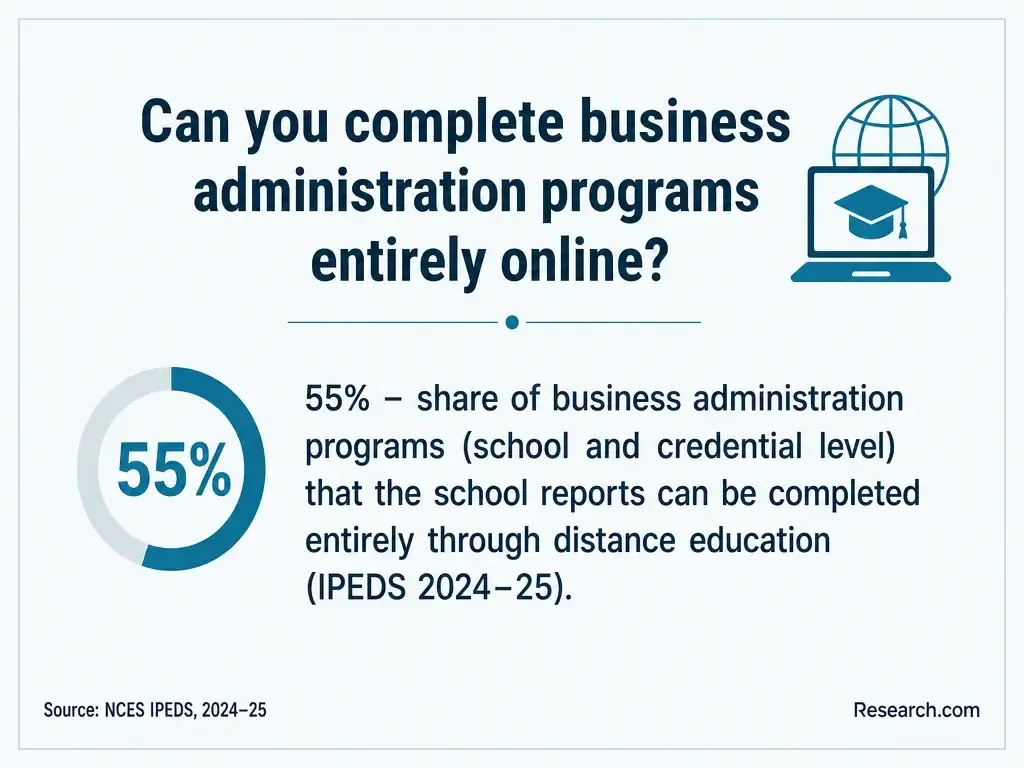
Business lectures, reading, discussion, and many spreadsheet assignments can often be completed remotely. An internship, employer project, proctored assessment, or scheduled presentation may still require attendance at a particular place or time. Check the requirements for the specific program rather than assuming "online" means self-paced or entirely remote.
The comparison below shows which format differences can change the real cost or usefulness of an Anchorage program.
| Consideration | Online or hybrid | On campus |
| Schedule | May reduce commuting, but live sessions and deadlines can remain | Regular travel and class times; easier face-to-face access |
| Applied work | May use remote projects; verify any required in-person activity | May provide easier access to campus-based group work and support |
| Cost | Compare technology, online, and any travel fees | Compare parking, transit, and time away from work |
| Transfer | Determined by course acceptance, not delivery mode alone | Also determined by course acceptance, not campus attendance alone |
Choose the format you can complete consistently. A lower advertised online tuition rate may not help if its required meeting times conflict with your job.
A reliable Anchorage-wide average for this specific degree cannot be stated without a consistent set of current, comparable program prices. Published tuition alone is not that average, and a schoolwide cost of attendance may not equal the cost of the business administration associate degree. Request a written estimate based on your residency, enrollment pace, and accepted transfer credits.
The following cost categories explain why the lowest tuition quote may not produce the lowest total bill.
| Cost category | What to verify |
| School charges | Tuition by credit, mandatory fees, and any online-course charges |
| Course materials | Textbooks, business software, and required computer access |
| Attendance | Anchorage commuting or travel for any required in-person activity |
| Time to completion | Extra terms, living expenses, and earnings forgone while studying |
| Offsets | Grants, scholarships, employer assistance, and accepted prior credits |
Calculate your expected net total to completion, not just a per-credit price. Include likely borrowing costs when comparing a faster, more expensive option with a slower one that lets you keep working.
Students at eligible institutions may qualify for federal grants, loans, or work-study through the Free Application for Federal Student Aid (FAFSA), subject to individual and program eligibility (Federal Student Aid). Alaska residents can also check current Alaska Education Grant and Alaska Performance Scholarship rules with the Alaska Commission on Postsecondary Education; eligibility and available funding should not be assumed.
Ask each school for a program-specific aid offer that separates grants from loans and identifies any conditions for keeping an award. Working adults should also ask employers whether tuition assistance covers part-time study and whether reimbursement requires a passing grade or continued employment. The lowest loan amount is not automatically the best choice if an unaffordable schedule makes completion less likely.
Requirements vary by institution. Applicants generally need to establish eligibility for college-level study and may be asked for prior transcripts, placement information, or proof of prerequisites. An open-admission policy, if offered, does not necessarily mean immediate entry into every business or math course. Confirm the current catalog and admissions rules with the school.
Before applying, ask whether previous college coursework, documented workplace learning, or examination-based credit can satisfy requirements - and whether those credits will also count toward your intended next step. A school may accept a credit toward its associate degree even when a later institution does not.
Common subjects include accounting fundamentals, economics, management, marketing, business communication, and spreadsheet applications, alongside writing, quantitative reasoning, and other general education. The exact mix matters: accounting and data-heavy courses can help with operations or bookkeeping support, while communication and customer-focused work can fit service or sales-support roles. Compare syllabi and required software, not merely course titles.
Business programs typically rely more on projects and workplace scenarios than on clinical or shop hours. If a program advertises an internship or employer project, ask whether it is required, who arranges the placement, and whether Anchorage employers can host it. Someone considering hands-on occupational study instead can research the most popular school for trade skills online, but should not assume its practical requirements resemble those of a business associate degree.
Depending on the current catalog, a program may allow electives or a concentration in accounting, marketing, entrepreneurship, or management. Availability should be verified rather than assumed from a school's general business offerings. Choose electives for a concrete next step: accounting and spreadsheets for financial records, marketing for customer analysis, or operations courses for scheduling and process support.
A narrow concentration is less useful if it displaces courses you need for transfer. Conversely, a broad transfer-oriented plan may offer less immediate software practice. If you are weighing distant education goals using lists of highest paid masters degrees, keep that separate from the immediate decision: this associate degree's value depends first on its own cost, completion prospects, and usable skills.
Start with the outcome you want: entry-level business work, a transfer pathway, or both. Then compare only programs that currently award a suitable associate degree and can fit your work and family schedule. A most-affordable ranking helps identify cost candidates, but its score does not measure whether your credits will transfer or whether the classes you need are offered when you can attend.
Use these checks to avoid the most consequential enrollment mistakes:
For a return-on-investment judgment, account for completion probability, program length, current earnings, plausible post-degree earnings, aid, borrowing, and the time over which benefits might accrue. Rankings and distant planning resources such as what is the easiest master degree to get cannot replace that associate-degree-specific calculation.
A realistic first step may be administrative, customer-service, sales-support, bookkeeping-support, or operations-support work, depending on coursework and prior experience. From there, employees may take on purchasing, scheduling, team coordination, or supervisory responsibilities. A concentration can help demonstrate interest, but it does not itself qualify someone for a manager position.
For someone already employed, the degree may be most valuable when it fills a documented skills gap needed for an internal move. For someone seeking a highly specialized occupation, a general business associate degree may be too broad; compare the actual job requirements before enrolling. Later-career resources about what is the easiest master degree to get are not a substitute for checking the first job this degree can help you pursue.
Business-related work spans multiple Anchorage industries, so demand for a degree alone is less informative than demand for the job titles and skills you intend to pursue. The U.S. Bureau of Labor Statistics projects 5.0% national employment growth for general and operations managers from 2025 to 2035. That projection concerns an experienced occupation across the United States; it is not an Anchorage hiring forecast for new associate degree graduates.
Review current local postings for recurring software, customer-service, accounting, and experience requirements. Compare those requirements with each program's courses and applied work. As employers adopt more digital workflows, demonstrated spreadsheet, communication, and process skills can help distinguish applicants - but a degree should be judged against specific openings, not a broad national growth rate.
Investing in an associate degree is an important decision. Research.com created its most-affordable ranking to help readers compare programs against other reported options in the same occupation and location, rather than against schools serving entirely different markets. Only programs with completions reported to the Integrated Postsecondary Education Data System (IPEDS) are included.
The most-affordable score considers tuition, cost of attendance, median student debt, and federal loan default rate. Its indicator weights are distributed using an entropy-based method, which gives more weight to measures that differ more across programs. Accreditation and other quality indicators are not part of this affordability score; readers should verify them separately. The Research.com team uses the following data sources in its ranking work. Some serve other occupations and should not be mistaken for business-program accreditation requirements:
A ranking narrows the search; it cannot establish that a current program fits a particular student's schedule, career goal, or credit-transfer plan. Research.com explains its broader approach on its methodology page.
# 1 position
# 2 position

It can be if its net cost and schedule are manageable and its courses support a job or transfer plan you have verified. Compare likely entry-level opportunities with your current earnings; do not use a manager's median wage as your expected return.
An AAS often emphasizes career-focused coursework, while an AA or AS commonly provides a more transfer-oriented structure. The best choice depends on the actual curriculum and written credit-transfer rules, not the initials alone.
Some programs may allow remote coursework, but live meetings, assessments, or an internship may have location requirements. Get the complete attendance and applied-work rules before enrolling.
Business administration is not itself a generally licensed occupation in Alaska. A particular regulated role or a business you operate may have separate requirements; check those requirements for your intended work.
Confirm that each candidate currently awards the associate degree, then request the same full-cost estimate from each: required credits, tuition, fees, materials, attendance costs, and aid. Compare the amount you expect to pay through completion, not advertised tuition alone.