# 1 position


Audited and Verified:
Our Editorial and Data Verification Process
Research.com uses government datasets, official education statistics and primary institutional information to support its career and degree guides. Our review process checks factual accuracy, occupational definitions, source dates and the requirements associated with the credentials discussed.
How This Article Was Fact-Checked
Our editorial team verifies salary estimates, employment projections, education requirements and program information against original data providers and official organizations. Salary figures are checked against the relevant occupational definitions and reporting periods. Information about licensure, accreditation and required in-person training is reviewed separately.
Fact-checked and verified on:

Co-Founder and Chief Data Scientist

Reviewed by Karolina Broda
Fact-Checker and Data Verification
Choosing a criminal justice associate degree in Washington means deciding whether you need a direct route toward employment, a degree designed for transfer, or both. The U.S. Bureau of Labor Statistics reports a May 2025 national median salary of $76,210 for police and sheriff's patrol officers - but that is not a starting salary or a guaranteed outcome. This guide explains program types, costs, career requirements, and job prospects. It also features a Best Criminal Justice Associate Degree Programs in Washington for 2027 ranking created by the Research.com team of data scientists to help students identify programs worth considering.
Expect a combination of general education and study of policing, courts, corrections, law, and the justice system. The degree's exact name matters less than its purpose: some associate degrees are structured for transfer, while others concentrate on applied career preparation. Washington's quarter-based colleges commonly describe associate degrees in quarter credits, so compare requirements in the same unit rather than assuming a credit at one institution equals a credit at another (Washington State Board for Community and Technical Colleges).
The distinction below helps you identify which curriculum to investigate before comparing individual schools.
| Associate-degree pathway | Best fit | Main question to verify |
| Transfer-oriented AA or AS | Students who want broad general education and transferable justice-related coursework | Does the receiving institution accept the degree and the specific major courses as intended? |
| Career-focused AAS or comparable applied degree | Students prioritizing occupational coursework and potential entry-level employment | Does the program include relevant applied work, and which credits transfer if plans change? |
An internship, observation placement, or scenario-based class may make coursework more relevant, but availability varies. Ask who arranges placements and whether eligibility depends on a background check. An academic degree is not the same as Washington police certification or an employer's hiring approval.
Potential settings include municipal police departments, county sheriff's offices, correctional facilities, courts, and organizations supporting public safety or victims. Actual entry requirements differ by employer and position: a justice-related degree may strengthen an application without being required or sufficient. Washington's state and local agencies also differ in hiring processes and work locations, so identify vacancies in the region where you can realistically live and commute (Washington State Criminal Justice Training Commission; Washington state and local government hiring notices).
Students interested in courts should inspect job descriptions before choosing a policing-heavy curriculum; records, procedure, writing, and case-management skills may be more relevant. For corrections or law-enforcement roles, ask about shift schedules, physical requirements, background standards, and employer-provided instruction before treating any college placement claim as an employment promise.
Pay depends on the occupation, employer, location, experience, and shift assignment - not the degree alone. The U.S. Bureau of Labor Statistics reports a May 2025 national median annual wage of $76,210 for police and sheriff's patrol officers. That figure covers workers across experience levels nationwide; it is not a Washington-specific wage or an estimate of what a new associate-degree graduate will earn.
For a useful local comparison, look up the current posted salary range for the exact Washington agency and role you want, then check whether the entry step assumes academy completion or prior service. Compare that range with your present earnings, likely study-related lost income, and expected debt. Do not use an experienced officer's median as the sole basis for a return-on-investment calculation.
A full-time student will generally plan around roughly two academic years, but the college's published credit map is the reliable measure. Quarter-credit requirements, placement in required writing or math courses, course sequencing, transfer credit, and internship scheduling can change the finish date. Working students may need longer; summer enrollment may shorten elapsed time while increasing the workload (Washington State Board for Community and Technical Colleges; individual college catalogs).
If speed matters, compare published term-by-term schedules rather than marketing claims about the fastest associate degree online. A shorter schedule is valuable only if required courses are offered when you need them and any in-person experience remains feasible.
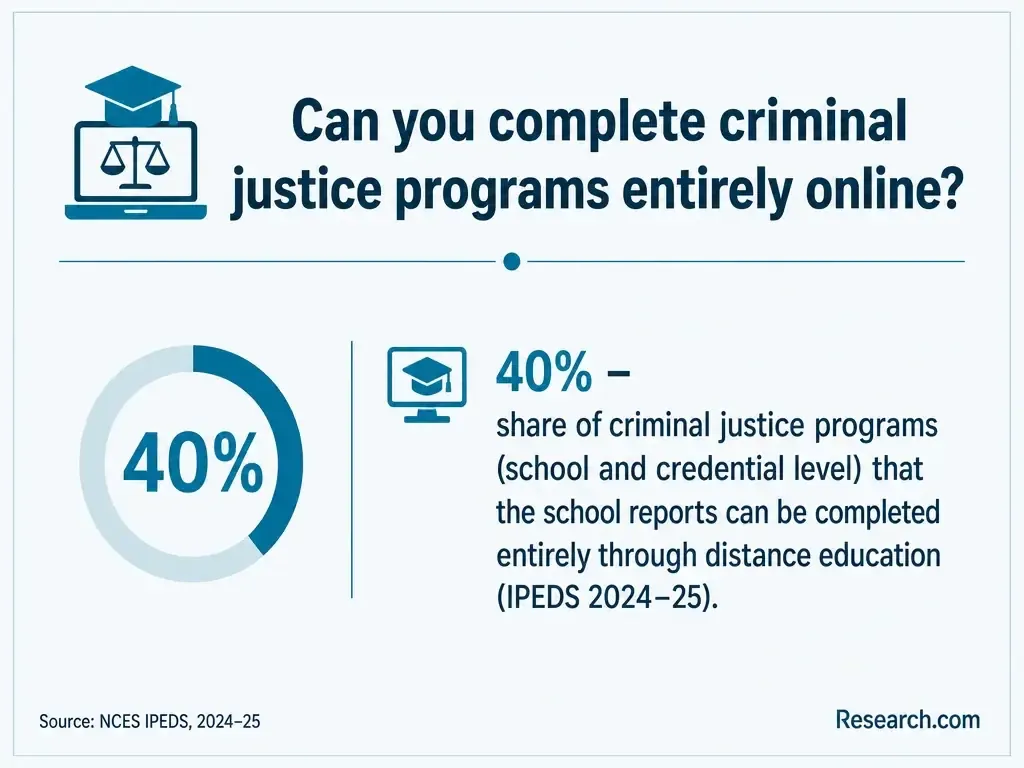
Online study can make reading, writing, and discussion courses easier to fit around shift work. On-campus study can offer more scheduled interaction and access to local agency contacts. A hybrid option may preserve both advantages, but a listed "online" degree can still include in-person exams, simulations, or an internship. Ask the college which requirements can actually be completed remotely.
Format alone says nothing about whether credits transfer or whether a graduate meets Washington employer and academy requirements. Even a list of best trade schools online cannot answer those program-specific questions. If practical experience matters to your goal, compare who secures a placement, where it occurs, and whether travel is required; this can be decisive for students far from a campus or agency site.
There is no single price that accurately describes every option: colleges publish different tuition and fee schedules, and a student's residency, course load, and time to completion affect the bill. Washington residents should confirm their tuition classification with each college; an online format does not by itself establish resident pricing. Compare the full cost to finish, not one term's advertised tuition (Washington State Board for Community and Technical Colleges; individual college tuition schedules).
These cost categories are worth comparing side by side because a lower tuition quote can conceal a higher total expense.
| Cost category | What to check |
| College charges | Tuition for all required credits, mandatory fees, and charges for repeat courses |
| Study and practical costs | Books, software, computer access, transportation, and any internship-related travel or required checks |
| Living and opportunity costs | Housing, childcare where applicable, and earnings reduced while studying |
| Offsets | Grants, scholarships, employer assistance, and eligible workforce funding |
Request a degree audit or term-by-term estimate. If you already have college credits, ask for a written evaluation before calculating savings; accepted credits may not satisfy the particular courses your degree requires.
Eligible students may use federal grants, work-study, or loans after filing the FAFSA. Washington residents may also qualify for the Washington College Grant or other state aid, subject to current eligibility rules. Awards depend on the student and the institution; a program's presence in a ranking does not establish aid eligibility (Federal Student Aid; Washington Student Achievement Council).
Start with the college's aid office and its current net-price estimate. Confirm that the specific associate degree and your enrollment pattern qualify, then compare grants and scholarships before loans. A directory of online fafsa schools can suggest questions to ask, but verify aid eligibility directly with the college and Federal Student Aid. Also ask a current employer whether tuition assistance covers required fees or only tuition.
Admission to a college and placement into a criminal justice course are separate questions. Applicants should check the institution's published admissions process, high-school completion or equivalent documentation, and writing or math placement rules. Some courses have prerequisites even when the associate degree itself has no selective admission process (individual college catalogs).
Do not confuse academic admission with eligibility for an internship or a future justice-system job. A placement or employer may impose background, age, driving, or physical standards. Ask about those conditions early if practical experience is central to your plan; enrolling in a degree does not waive an agency's requirements (Washington State Criminal Justice Training Commission; individual employer requirements).
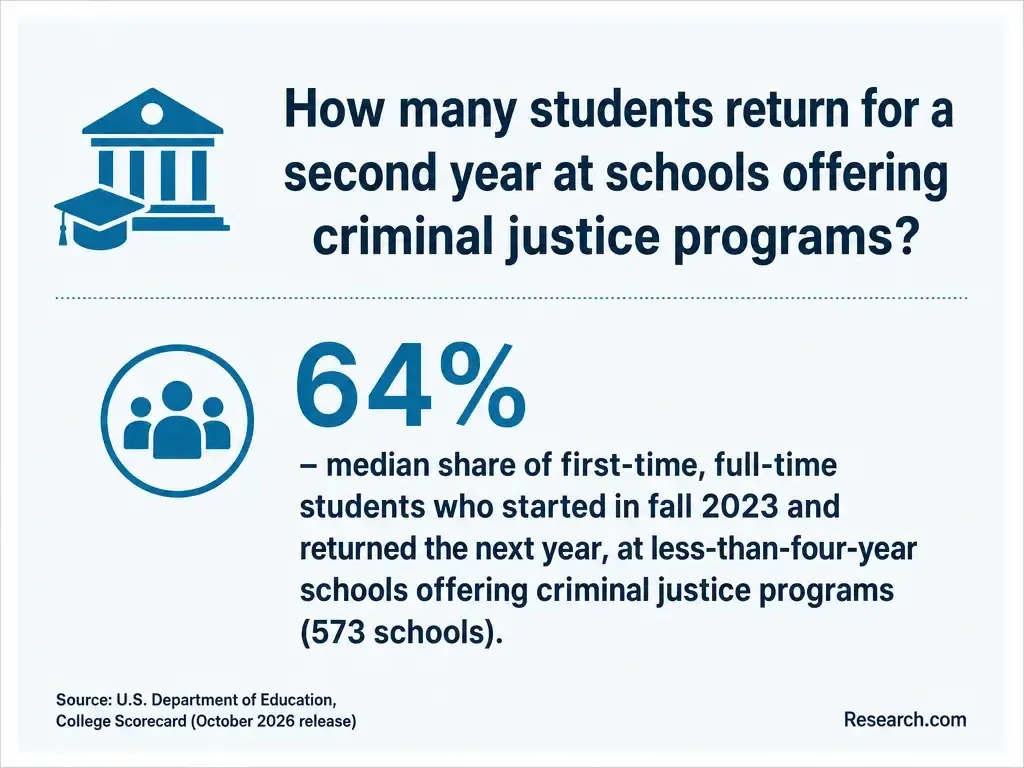
Common subjects include introduction to criminal justice, criminal law and procedure, policing, courts, corrections, ethics, and criminology. General education typically develops writing, quantitative reasoning, and communication. The useful comparison is not the number of justice-related course titles but whether the required courses build skills for your intended next step (individual college catalogs).
For policing, look for report writing, evidence handling, de-escalation concepts, and ethical decision-making. For court-facing work, pay closer attention to legal research, records, and procedure. A class may teach these concepts without conferring authority to perform regulated duties. If a program advertises fieldwork, confirm its hours, supervision, placement process, and whether it is required for graduation.
Specialization at the associate level may take the form of electives or a named emphasis in law enforcement, corrections, courts, or related public-safety work. Availability varies by college, and an emphasis may be too narrow if you want maximum flexibility. Compare required courses before assuming similarly titled degrees prepare students for the same work (individual college catalogs).
Choose an emphasis when it adds relevant coursework or supervised experience without delaying completion. If a short course advertised among quick online certifications that pay well catches your attention, do not assume it provides the general education, associate degree, or agency-specific eligibility you need. Equally, do not pay for specialized electives that your target employer neither requires nor values.
Start with the role or transfer destination, then work backward to the degree requirements. Spokane Community College, Walla Walla Community College, Bellevue College, Columbia Basin College, and Everett Community College are schools a Washington student may investigate, but confirm each school's current associate-degree offerings rather than assuming every campus offers the same criminal justice pathway.
The following checks turn a shortlist into a decision grounded in your goals and budget:
A ranking is a starting point, not a substitute for these checks. A common mistake is selecting the lowest tuition or most convenient online schedule while overlooking nontransferable courses, limited course availability, or an impractical field placement. For return on investment, weigh aid, debt, completion likelihood, forgone earnings, and realistic post-degree opportunities over the period you expect to work - not a single advertised salary.
An associate degree may support applications for policing, corrections, court-support, records, or other public-safety roles, depending on the employer's requirements. These paths do not share a single entry standard. In particular, Washington police certification follows the applicable agency hiring and state academy process; finishing a college degree is not certification (Washington State Criminal Justice Training Commission).
Career progression may involve employer instruction, experience, specialized assignments, and promotion rather than another academic program. When weighing longer-term earnings, do not treat lists of best paying bachelor degrees as forecasts for an associate-degree holder. Instead, examine posted pay steps and promotion rules for the Washington employers you would actually consider.
The U.S. Bureau of Labor Statistics projects 3.5% national employment growth for police and sheriff's patrol officers from 2025 to 2035. That is an occupation-level projection, not a forecast of openings for Washington associate-degree graduates. Hiring also depends on agency budgets, vacancies, applicant screening, and willingness to work particular shifts or locations.
Before enrolling, review current Washington agency postings in your preferred area. Note how many positions are genuinely entry-level, whether an associate degree is preferred or required, and whether the employer sponsors the required academy process. If local opportunities are scarce, determine whether you can commute or relocate before choosing a degree chiefly for one occupation.
Investing in an associate degree is a significant decision. Research.com developed its ranking to help readers compare programs against relevant alternatives, rather than rely on a school's name or advertised tuition alone. The team checks multiple education datasets and considers outcomes, costs, recognition, and student support; only programs with completions reported to IPEDS are eligible. That coverage rule does not mean an omitted program is unavailable or lacks quality.
For best-program rankings, student outcomes include completion and full-time and part-time retention. Earnings and return-on-investment measures include median earnings one year after completion and earnings relative to annual attendance cost. Cost measures include resident and nonresident tuition, attendance cost, median debt - including for students who withdrew - and federal loan default rates. Institutional accreditation, relevant program recognition, and student support make up the quality measures. Relevant programmatic accreditation or industry recognition receives 20% of the score, institutional accreditation 10%, and student support 10%; outcomes, earnings, and costs share the remaining 60% through entropy-based weighting. Most-affordable-program rankings instead score only costs and debt, with entropy-based weights; accreditation and other quality measures are not part of that score.
The following sources contribute to the ranking's cross-disciplinary data and verification process. Some occupation-specific organizations listed here do not accredit criminal justice associate degrees, so their inclusion should not be read as a requirement for these programs.
Use the ranking to build a shortlist, then confirm each program's current curriculum, price, transfer terms, and career fit directly with the college. Research.com explains the broader scoring approach on its methodology page.
# 1 position
# 2 position
# 3 position

# 4 position

# 5 position

# 6 position

# 7 position

# 8 position

# 9 position

# 10 position

# 11 position
# 12 position

# 13 position
# 14 position

# 15 position

# 16 position

# 17 position
# 18 position

# 19 position

Do not assume so. Check the hiring standards of the specific agency and Washington's academy and certification requirements. A degree can provide useful knowledge but does not replace the required hiring and training process (Washington State Criminal Justice Training Commission).
Choose based on your next step. A transfer-oriented degree generally prioritizes broadly applicable coursework; an applied degree generally prioritizes occupational study. Ask how every required course will count toward your goal before enrolling.
That depends on the college's current course schedule and any in-person assessment or fieldwork requirements. Confirm the requirements for the whole degree, not just its online classes.
No. Employers set their own hiring standards, and some roles involve screening or additional instruction. Compare actual entry-level job postings with the degree's curriculum before committing.
Compare the full cost after aid with your likely completion time, current earnings, borrowing needs, and realistic local job options. Request a written credit evaluation and cost estimate; neither a ranking position nor an occupational median wage establishes your personal return.