# 1 position


Audited and Verified:
Our Editorial and Data Verification Process
Research.com uses government datasets, official education statistics and primary institutional information to support its career and degree guides. Our review process checks factual accuracy, occupational definitions, source dates and the requirements associated with the credentials discussed.
How This Article Was Fact-Checked
Our editorial team verifies salary estimates, employment projections, education requirements and program information against original data providers and official organizations. Salary figures are checked against the relevant occupational definitions and reporting periods. Information about licensure, accreditation and required in-person training is reviewed separately.
Fact-checked and verified on:

Co-Founder and Chief Data Scientist

Reviewed by Karolina Broda
Fact-Checker and Data Verification
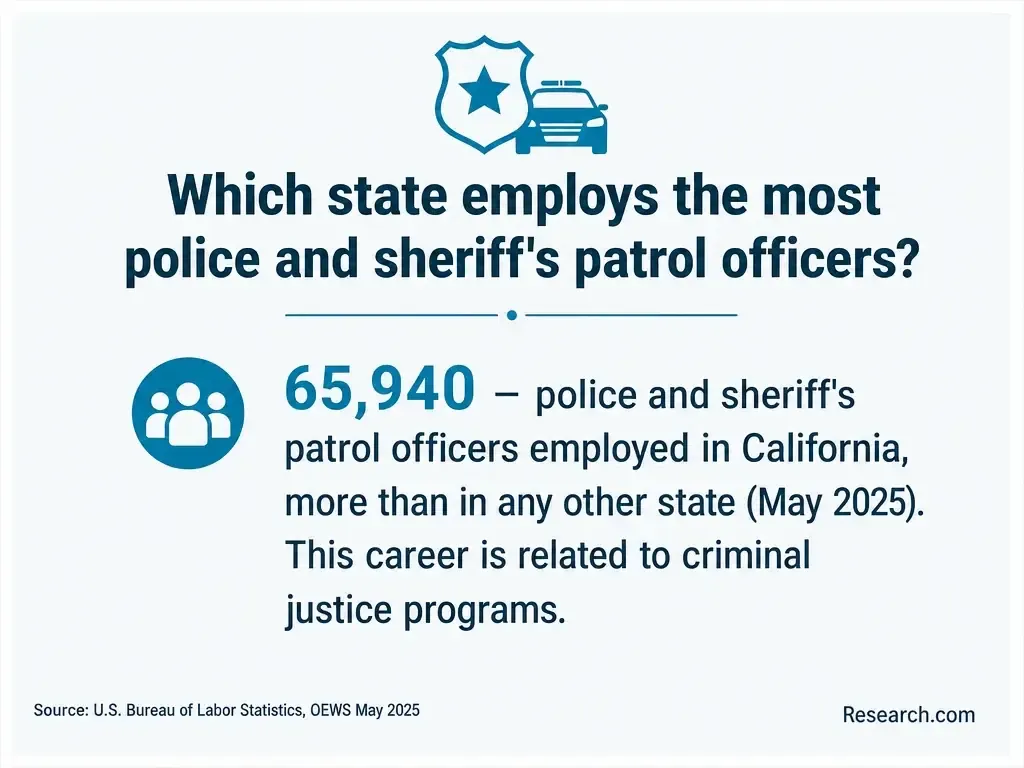
Choosing an affordable criminal justice associate degree near Cypress means looking beyond tuition: the degree must also fit your career goal and budget. The Research.com team of data scientists created the Most Affordable Criminal Justice Associate Degree Programs in Cypress for 2027 ranking to help students identify programs worth considering. The U.S. Bureau of Labor Statistics projects 3.5% national growth for police and sheriff's patrol officers from 2025 to 2035 - but a degree alone does not qualify someone for the job. This guide explains the costs, coursework, career requirements, and trade-offs behind an informed choice.
Expect a mix of general education and criminal justice coursework covering law, courts, policing, and corrections. At Cypress College, look for the current Administration of Justice catalog entry rather than assuming every program with a similar title awards the same degree or has the same requirements. Catalog descriptions and academic advising are the sources for the exact award, course sequence, and any experiential component (Cypress College).
The distinction between degree types matters more than the name alone. This comparison helps you identify the award that matches your immediate goal.
| Associate degree pathway | Best fit | What to verify |
| Transfer-oriented AA, AS, or associate degree for transfer, if offered | Students who want a planned route into further study | Required courses, applicable transfer agreements, and whether every course will count toward the intended destination |
| Career-focused AA, AS, or AAS, if offered | Students prioritizing job-related coursework | Employer-relevant skills, field experience, and how much coursework remains transferable |
An associate degree can build writing, evidence evaluation, interviewing, and report-writing skills. It is not a police academy or a guarantee of an agency appointment. If speed to paid work matters most, compare the degree's completion timeline with direct-entry hiring routes rather than assuming more coursework always improves your prospects. A broader list of quick careers that pay well can provide context, but use actual Cypress-area hiring requirements to evaluate this choice.
Cypress sits in Orange County within reach of municipal police departments, county agencies, courts, and private-sector security employers. Those different employers do not share one hiring standard. An associate degree may support applications for administrative, records, security, or public-safety support roles; sworn law-enforcement work involves separate agency selection and California Peace Officer Standards and Training (POST) requirements (California POST).
Job title and employer matter when judging whether the degree is worth its cost. Ask local agencies whether the role you want requires a degree, values college credits, or instead prioritizes a particular examination, background investigation, or work experience. If your interests lie outside public safety, comparisons of trade school high paying jobs describe a different labor market and should not be treated as criminal justice salary evidence.
The clearest national benchmark for a common criminal justice goal is the U.S. Bureau of Labor Statistics (BLS) May 2025 median annual wage of $76,210 for police and sheriff's patrol officers. That is the midpoint for employed officers nationwide, including experienced workers - not an offer to a new Cypress College graduate. Pay for records, security, and court-support positions follows different occupational patterns.
For a useful local estimate, identify an actual Orange County job title and compare its posted pay range with its entry requirements. Consider shift work, benefits, and commuting alongside base pay. Do not use a sworn-officer median to calculate the return on a degree if your intended role is civilian or if you have not confirmed your eligibility for sworn employment.
California associate degrees generally require at least 60 semester units, but the number of terms depends on course availability, placement, accepted prior credits, and how many units you can take while working (California Community Colleges Chancellor's Office). A full-time schedule may allow completion in roughly two academic years; part-time attendance usually takes longer. Check the current Cypress College catalog and a personalized education plan before committing to a completion date.
Ask which required criminal justice courses are offered each term. A low per-term bill can become a costly choice if an infrequently offered course extends your enrollment or reduces your working hours. Confirm any fieldwork or internship schedule before assuming it will fit around a job.
Online coursework may make reading, discussion, and written assignments easier to schedule around work. On-campus classes can offer face-to-face practice in interviewing, presentations, and case discussion. Hybrid study combines formats, but its required campus meetings and examination rules vary by course. Check the actual Cypress College class schedule; a program's advertised format does not establish that every required course is offered remotely (Cypress College).
Neither online nor campus delivery substitutes for agency screening or California POST requirements for a sworn role. If a course includes observation, field experience, or an internship, confirm the site, hours, supervision, and transportation requirements before enrolling. An online student still needs a workable plan for any required in-person activity.
There is no single reliable "average" bill for every Cypress student: enrollment charges can depend on California residency, unit load, and applicable exemptions or aid. Compare a current Cypress College cost-of-attendance estimate with your own course plan, not just a published tuition figure (Cypress College; California Community Colleges Chancellor's Office).
These cost categories explain why two students in the same degree program may spend different amounts.
| Cost category | Why it changes the decision |
| Enrollment charges and mandatory fees | Residency classification and required campus charges affect the direct bill. |
| Books, software, and technology | Course materials and reliable computer access add costs beyond enrollment. |
| Transportation and any field placement | Commutes to class or an approved site can affect both spending and scheduling. |
| Living costs and reduced work hours | These may outweigh differences in advertised tuition. |
| Career-entry expenses, if applicable | Agency applications, background-related requirements, or academy-related costs must be checked separately. |
To judge return on investment, compare the likely total after grants and scholarships with your available earnings while studying, completion probability, potential debt, and the pay requirements of a specific target job. A longer time horizon matters: a higher wage years after gaining experience is not immediate repayment of college costs.
Eligible students can explore federal grants, work-study, and loans through the Free Application for Federal Student Aid (FAFSA); California residents may also qualify for state or community-college assistance under the applicable rules. Award amounts and eligibility depend on the student and school, not merely the major (Federal Student Aid; California Student Aid Commission; Cypress College).
Start with the college's financial aid office and ask for an estimate tied to your enrollment intensity and residency status. Then compare grants and scholarships separately from loans: borrowed funds reduce today's bill but create a later repayment obligation. If employed, ask whether your employer reimburses approved coursework and whether reimbursement arrives before or after you must pay the college.
College admission and entry into a specific course are separate questions. Review Cypress College's current admission steps, placement and prerequisite information, and the Administration of Justice catalog requirements; a course may have prerequisites even when the college offers broad access to applicants (Cypress College).
Do not mistake admission to an associate degree for clearance to work in law enforcement. California agencies apply their own hiring standards, and peace-officer candidates face POST-related selection and training requirements (California POST). If a past event could affect a target role's background review, seek authoritative guidance about that role before spending money on coursework primarily for that career.
Criminal justice associate degrees commonly pair general education - such as composition and quantitative reasoning - with courses in criminal law, policing, courts, corrections, and ethics. The exact Cypress College requirements depend on the current catalog and degree awarded (Cypress College). General education is particularly important if you want coursework that can be applied to further study rather than only a concentration in the major.
Look beyond course titles for assignments that practice clear incident-style writing, legal-source research, evidence evaluation, and communication with the public. Ask whether practical work is classroom-based, optional, or required; similarly named programs need not provide the same field experience.
Students may be able to shape an associate degree through approved electives in policing, corrections, legal processes, or related subjects, but an elective interest is not necessarily a formally named specialization. Verify what the current Cypress College catalog actually awards and whether a chosen elective satisfies the degree requirements (Cypress College).
Choose electives around a specific goal: policing-focused coursework may inform agency applications, while courts-focused coursework may better suit someone exploring civilian legal-support work. Neither choice replaces an employer's entry requirements. If comparing occupations based on additional qualifications, a list of high paying certification programs is a separate career-planning resource, not evidence that this associate degree confers a professional certification.
Start with the job or next educational step, then work backward to the degree award and required courses. An affordability ranking narrows the cost comparison; it cannot tell you whether a program meets your personal objective. Use these checks to avoid the most consequential enrollment mistakes:
A red flag is an unqualified claim that the cheapest degree guarantees a police job or a particular salary. For a longer-range education decision, highest paying master's degree addresses a different question; its earnings figures should not be used to justify the cost of a Cypress associate degree.
Possible paths include applications for civilian public-safety support, records, security, and court-related work, as well as pursuing agency selection for sworn policing. The associate degree may demonstrate relevant study, but job access depends on the particular employer's qualifications and, for peace-officer work, additional California requirements (California POST; U.S. Bureau of Labor Statistics).
Career progression also differs by role. Experience, employer-provided instruction, or a successful agency hiring process may matter more than additional electives for a particular opening. If planning much further ahead, easiest master degree to complete concerns a separate educational decision and should not be confused with an entry route available solely because someone earned this associate degree.
The U.S. Bureau of Labor Statistics projects 3.5% growth for police and sheriff's patrol officers from 2025 to 2035. That national projection suggests continued hiring activity, but it does not count openings reserved for associate degree holders or predict vacancies in Cypress. Department budgets, retirements, and agency-specific standards can change the opportunities a local applicant actually sees.
Search current Orange County-area postings by job title, then note which accept associate-level education and which require separate selection or experience. Compare civilian and sworn openings rather than grouping them under "criminal justice jobs." If a short route to employment is the priority, lists of quick careers that pay well offer broader context; the decisive evidence remains the requirements and pay in openings you could realistically pursue.
Investing in an associate degree is consequential, so the Research.com team evaluates programs against other reported options in the same occupation and location. The most-affordable ranking considers tuition, cost of attendance, median student debt, and federal loan default rates. An entropy-based method assigns more weight to cost and debt indicators that vary more across programs. Accreditation and other quality measures do not contribute to this affordability score; readers should check them separately.
Only programs with completions reported to the Integrated Postsecondary Education Data System (IPEDS) are eligible. The team uses the following sources to assemble and check ranking information. Some cover other occupations and should not be interpreted as criminal justice program accreditors:
The ranking is a starting point for comparing reported costs, not a promise of the lowest personal bill or a measure of police hiring eligibility. Data coverage and reporting periods vary; a 2027 ranking label does not mean every underlying figure describes 2027. See Research.com's ranking methodology for more information.
# 1 position
# 2 position
Review its current Administration of Justice catalog entries for the precise associate degree award, required courses, and available formats. Confirm the details with an adviser before applying them to a career plan (Cypress College).
No. Compare your total cost after aid, completion schedule, degree requirements, and fit with a specific job or transfer goal. A low published price may not be your lowest-cost route to completion.
Not by itself. Agencies conduct their own selection, and California peace-officer roles have separate POST-related requirements. Check the agency and California POST before relying on a degree for eligibility.
That depends on current course offerings and any in-person requirements. Ask Cypress College whether every required course is available in your preferred format and whether field experience requires attendance at a site.
Use the posted entry pay for a job you qualify to pursue, not the national median for experienced officers. Weigh that against your net college costs, likely debt, time to completion, and earnings you may forgo while studying.