# 1 position


Audited and Verified:
Our Editorial and Data Verification Process
Research.com uses government datasets, official education statistics and primary institutional information to support its career and degree guides. Our review process checks factual accuracy, occupational definitions, source dates and the requirements associated with the credentials discussed.
How This Article Was Fact-Checked
Our editorial team verifies salary estimates, employment projections, education requirements and program information against original data providers and official organizations. Salary figures are checked against the relevant occupational definitions and reporting periods. Information about licensure, accreditation and required in-person training is reviewed separately.
Fact-checked and verified on:

Co-Founder and Chief Data Scientist

Reviewed by Karolina Broda
Fact-Checker and Data Verification
The cheapest tuition is not necessarily the cheapest route into criminal justice: fees, commuting, delayed completion, and credits that do not transfer can change the bill. The U.S. Bureau of Labor Statistics projects 3.5% national employment growth for police and sheriff's patrol officers from 2025 to 2035, but an associate degree alone does not qualify someone for every role. The Research.com team of data scientists created its Most Affordable Criminal Justice Associate Degree Programs in Nevada for 2027 ranking to help students make an informed choice about programs worth considering. This guide explains the costs, pathways, and career requirements behind that choice.
Expect a mix of general education and study of policing, courts, corrections, criminal law, and the ethical limits of government authority. An associate degree can support entry-level applications or further study, but its value depends on the degree awarded and the requirements of the position you want. College coursework is distinct from an employer's academy, background investigation, or job-specific instruction.
The degree label is a useful first filter, not proof of a particular curriculum. Compare each college's current catalog and ask how its requirements serve your goal.
| Associate pathway | Typical emphasis | Best question to ask |
| Associate of Arts (AA) | Broad general education and criminal justice coursework, often organized for transfer | Which courses transfer as requirements rather than electives? |
| Associate of Science (AS) | Transfer-oriented general education, sometimes with a different quantitative or science mix | Does this particular program offer the criminal justice courses I need? |
| Associate of Applied Science (AAS) | More occupation-focused coursework, where offered | Which credits transfer, and what practical work is included? |
For prospective police officers, degree study may strengthen writing and analytical skills, but hiring standards and academy requirements remain separate. For a prospective transfer student, an apparently inexpensive AAS can cost more overall if credits must be repeated. Confirm the exact award and catalog year with the college rather than assuming all similarly named programs work the same way.
Potential workplaces include local law enforcement and detention agencies, state corrections, court offices, private security employers, and organizations that handle investigations or compliance support. Duties and entry standards differ sharply: a court-support position, a detention job, and a sworn patrol position are not interchangeable. The U.S. Bureau of Labor Statistics describes distinct education and work requirements across protective-service and legal-support occupations.
Location affects access. Students near Las Vegas, Reno, or Carson City may be able to compare more nearby agencies and shift schedules; rural students should check where field experiences and interviews occur before committing to a campus commute. An agency's current job posting is a better guide to eligibility than a degree title alone.
There is no single "criminal justice associate degree salary." The U.S. Bureau of Labor Statistics reports a $76,210 national median annual wage in May 2025 for police and sheriff's patrol officers. That figure covers workers across experience levels and employers; it does not describe what a new Nevada graduate will earn. It also should not be applied to corrections, security, or court-support roles.
For a useful Nevada estimate, compare current pay schedules or job advertisements for the specific occupation and agency, including academy or probationary pay, shift differentials, and benefits. Then compare likely earnings against your current wages and the cost of completing the degree. Do not treat the national occupational median as a return-on-investment forecast.
Many associate degree plans are built around roughly 60 semester credits and two academic years of full-time study. Actual requirements depend on the college and degree; part-time attendance, developmental coursework, and courses offered only in certain terms can extend the schedule. Check the current catalog and a term-by-term plan rather than relying on a general "two-year" description.
Speed and affordability can pull in opposite directions. Taking fewer credits may preserve work income but add semesters of fees and delay a career move. Before choosing an accelerated schedule, confirm that required criminal justice classes are offered when needed and that you can finish general education requirements without sacrificing grades or eligibility for aid.
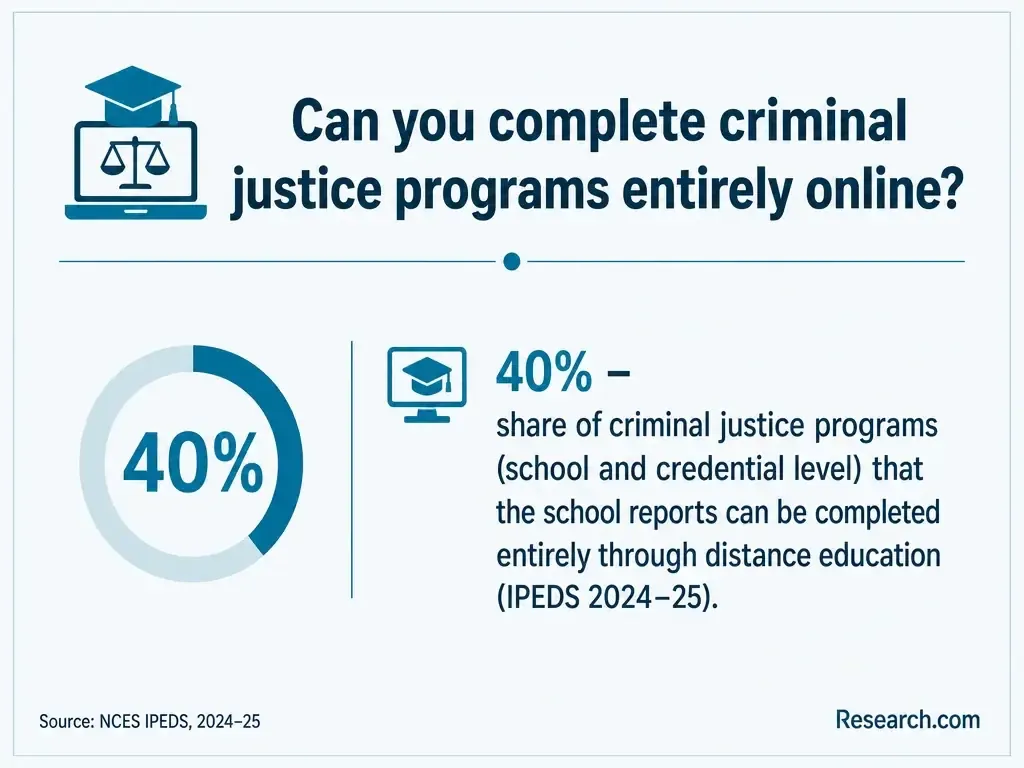
Online coursework can reduce travel for working adults and rural residents. On-campus study can make it easier to meet instructors, use student services, and attend scheduled activities. Neither format is inherently more transferable or more acceptable to employers; the institution, degree requirements, and particular job matter more.
Reading, writing, and some criminal justice courses may be available remotely. A course with simulations, supervised experience, an internship, or another required activity may not be. Ask for a list of every in-person requirement, its location, and who arranges a placement. An online degree does not replace an employer's in-person hiring, academy, or field requirements.
If remote access is essential, compare the actual cost and aid eligibility of associate programs rather than assuming a listing of the best cheap online schools that accept FAFSA confirms that a specific criminal justice degree is available online.
There is no single reliable price for every Nevada student: a published tuition rate is not a completed-degree bill, and resident and nonresident rates can differ. For a 2027 start, request each college's applicable-year tuition and mandatory fee schedule, then price the credits in your individual degree plan. Compare Truckee Meadows Community College, the College of Southern Nevada, Great Basin College, and Western Nevada College using the same enrollment pace and residency assumption.
Use the following cost categories to turn advertised tuition into a comparable budget. Include an item only if it applies to your plan, but do not overlook costs that occur outside the tuition bill.
| Cost category | What to verify |
| College charges | Tuition by residency status, mandatory fees, online-course fees, and repeated courses |
| Study expenses | Books, software, computer access, and any course-specific materials |
| Attendance expenses | Travel to campus or a placement, parking, housing, and childcare where applicable |
| Career-entry expenses | Any employer-required screening, physical examination, or equipment not paid for by the employer |
Subtract grants and scholarships you are likely to receive, then account for borrowing and income you may forgo while studying. A sound return-on-investment comparison also considers completion probability, current earnings, realistic earnings after completion, and how long the benefit might last. Published tuition alone cannot settle whether the degree is worth it.
Students at eligible institutions may qualify for federal grants, loans, or work-study after completing the Free Application for Federal Student Aid (FAFSA); eligibility depends on the student and program, according to Federal Student Aid. Nevada also offers the Nevada Promise Scholarship for eligible community college students. It is a last-dollar award with application, service, and other conditions, not an automatic waiver for every applicant, according to the Nevada System of Higher Education.
Ask the financial aid office for a personalized estimate showing grants separately from loans. Confirm deadlines and whether part-time enrollment changes eligibility. Employer tuition assistance can also reduce the bill, but check repayment terms if you leave the job. When comparing an associate degree with a future cheapest online bachelor's degree, keep the associate-stage aid and costs separate so the advertised price of a later program does not distort today's decision.
College admission and entry to a particular criminal justice course are separate questions. Expect to provide prior school records and complete the college's placement or advising process; specific rules, prerequisites, and residency documentation depend on the institution and catalog year. Ask whether previous college credits or assessed prior learning can satisfy requirements before repeating coursework.
Do not confuse admission to an associate degree with eligibility for a sworn position. Nevada peace-officer standards and agency hiring processes can include age, background, physical, and academy requirements; the Nevada Commission on Peace Officer Standards and Training and the hiring agency are the appropriate sources for current rules. A college's acceptance decision does not waive them.
Typical coursework covers the criminal justice system, substantive or procedural criminal law, policing, courts, corrections, and ethics, alongside composition, mathematics, and other general education. The exact mix varies by degree plan. Look for assignments that develop report writing, evidence evaluation, communication, and awareness of constitutional limits - skills that apply across several justice-related workplaces.
Review course descriptions rather than relying on a compelling specialization name. If your goal is employment, ask whether a program includes relevant simulations, visits, or supervised work and whether participation is required or optional. If your goal is transfer, compare how each course will be accepted before enrolling in electives.
Colleges may offer different concentrations or elective clusters in areas such as law enforcement, corrections, or security. Availability changes by catalog and campus, so verify the courses required for an awarded degree rather than assuming that an advertised interest area is a formal specialization. An elective sequence can still be useful if it builds skills relevant to a target employer.
Choose a focus after checking entry requirements for the role. A law-enforcement emphasis does not substitute for Nevada peace-officer requirements; a corrections-oriented plan should be judged against the duties and qualifications in actual agency postings. Students who want flexibility may benefit more from transferable general education than from narrowly chosen electives.
Start with the outcome you need: an affordable associate degree for a particular job, or an associate pathway with credits that will count toward further study. A low-cost ranking is a useful shortlist, but it cannot establish your personal net price, course availability, or job eligibility. Use these checks before accepting an offer:
Be wary of a program that promises a police job, treats institutional accreditation as proof of occupational eligibility, or quotes tuition without required fees. Also be wary of assuming that search results for an accelerated bachelor degree answer whether an associate degree's credits will transfer; only the receiving institution can confirm how it will apply them.
An associate degree may support applications for court-support, detention, security, or agency-administration work, depending on the employer. Sworn policing is a separate hiring pathway with agency selection and required preparation beyond college coursework. Some students use the degree to develop writing and analytical skills before seeking advancement; others prioritize transferable credits. None of these outcomes follows automatically from graduation.
Map the job first, then judge the degree against it. If a target employer does not require college study, compare the degree's likely advantages with its cost and time away from work. If further academic study is your goal, avoid treating lists of the highest paying masters degree options as evidence of the return on a Nevada criminal justice associate degree; the relevant immediate questions are transferable credits and your next-step costs.
The U.S. Bureau of Labor Statistics projects 3.5% national growth from 2025 to 2035 for police and sheriff's patrol officers. This describes one possible occupation, not Nevada demand for all criminal justice graduates. Hiring can depend on public budgets, vacancies, agency standards, and an applicant's ability to work the required shifts or location.
For a Nevada-specific decision, review current postings from agencies within commuting distance and note which require an associate degree, prefer college credits, or offer their own preparation. Check whether the roles are concentrated near where you can live; a lower-cost program may offer little practical advantage if the jobs you want require a move. A page about the easiest phd programs is not a substitute for this local, occupation-level check.
Investing in an associate degree is an important decision, so the Research.com team uses comparable education and cost data to help readers assess local options. For the most-affordable ranking, programs are compared with programs in the same field and location; only programs with completions reported to IPEDS are eligible. The score considers tuition, cost of attendance, median student debt, and federal loan default rate. An entropy-based method gives more weight to cost and debt indicators that differ more across programs. Accreditation, outcomes, and other quality measures are not part of the affordability score, so readers should check them separately before enrolling.
The ranking draws on the following data sources. Some occupation-specific sources support rankings in other fields rather than criminal justice; their inclusion here does not imply that those organizations approve a criminal justice degree.
This approach helps identify lower-cost options for further investigation, not a guaranteed lowest personal bill. Published prices may reflect a different academic year from a reader's intended 2027 enrollment, and aid eligibility varies. Readers can review the full Research.com methodology before using the ranking alongside current college estimates.
# 1 position
# 2 position
# 3 position

# 4 position
# 5 position

# 6 position

# 7 position
Criminal Justice/Safety Studies
Delivery mode: On Campus (May Include Online Courses)
87.98
/ 100
Final score
Accreditation
Institutional accreditation from Northwest Commission on Colleges and Universities.
Western Nevada College earned a Research.com Affordability Score of 87.98/100, with $4,445 annual in-state tuition among the verified supporting factors.
# 8 position
Criminal Justice/Police Science
Delivery mode: On Campus (May Include Online Courses)
87.98
/ 100
Final score
Accreditation
Institutional accreditation from Northwest Commission on Colleges and Universities.
Western Nevada College earned a Research.com Affordability Score of 87.98/100, with $4,445 annual in-state tuition among the verified supporting factors.
There is no universal winner for every student. Compare current resident or nonresident tuition, mandatory fees, required credits, aid, and travel costs at eligible colleges before deciding.
An AA generally merits closer attention if transfer is the priority. An AAS may fit an occupation-focused goal, but check its courses and transfer treatment; the degree label alone is insufficient.
No. Agency hiring and Nevada peace-officer standards are separate from earning a degree. Check current requirements with the hiring agency and the Nevada Commission on Peace Officer Standards and Training.
Some coursework may be online. Confirm whether your chosen degree has campus activities, exams, or field requirements and whether it serves your employment or transfer goal.
It may be if its credits or skills advance a specific goal at a manageable net cost. Compare that benefit with the time to finish, debt, current earnings, and the target employer's actual requirements.