# 1 position


Audited and Verified:
Our Editorial and Data Verification Process
Research.com uses government datasets, official education statistics and primary institutional information to support its career and degree guides. Our review process checks factual accuracy, occupational definitions, source dates and the requirements associated with the credentials discussed.
How This Article Was Fact-Checked
Our editorial team verifies salary estimates, employment projections, education requirements and program information against original data providers and official organizations. Salary figures are checked against the relevant occupational definitions and reporting periods. Information about licensure, accreditation and required in-person training is reviewed separately.
Fact-checked and verified on:

Co-Founder and Chief Data Scientist

Reviewed by Karolina Broda
Fact-Checker and Data Verification
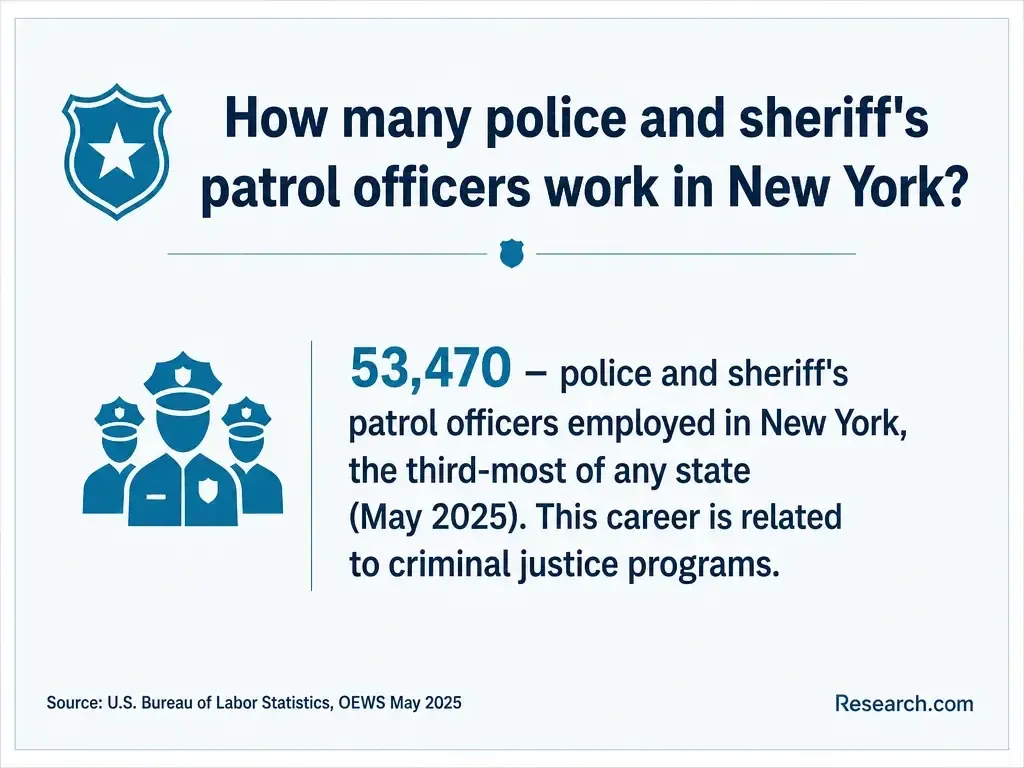
For a Plattsburgh student, the cheapest criminal justice associate degree is not necessarily the best investment: tuition, travel, transferability, and hiring requirements can change the answer. The U.S. Bureau of Labor Statistics reports a May 2025 national median wage of $76,210 for police and sheriff's patrol officers - but that is not a starting salary. This guide explains how to compare those trade-offs. It accompanies the Most Affordable Criminal Justice Associate Degree Programs in Plattsburgh for 2027 ranking, created by the Research.com team of data scientists to help students make an informed choice about programs worth considering.
Expect a combination of general education and study of policing, courts, corrections, law, and the justice system. An associate degree can support job applications or further study, but its value depends on the courses and experience it actually includes. Compare the awarded degree before comparing programs with similar names.
The distinctions below help you identify the pathway to investigate; they are not a substitute for a course-by-course transfer review.
| Degree pathway | Usual emphasis | Best question to ask |
| Associate of Arts (AA) | Broad general education and transfer-oriented study | Will the intended receiving institution accept the required courses? |
| Associate of Science (AS) | General education and a more structured disciplinary sequence | How do the major and elective credits apply to the next program? |
| Associate of Applied Science (AAS) | Career-focused coursework, sometimes with applied learning | Which jobs recognize this preparation, and which credits transfer? |
Ask Clinton Community College which criminal justice associate degree it currently awards and whether field experience is required, optional, or unavailable. Do not assume that a classroom course provides academy instruction, a placement, or eligibility for a specific public-safety job.
Potential workplaces include local police and sheriff's agencies, courts, correctional facilities, security employers, and organizations that support people involved with the justice system. Plattsburgh's proximity to the Canadian border may also make federal employment worth exploring. Each employer sets its own qualifications, however, and some openings may require experience, testing, or relocation.
Start with the job you want, not the degree label. For New York policing, review the hiring agency's civil-service process and the New York State Division of Criminal Justice Services' training standards; an associate degree does not replace selection, background screening, or required academy preparation. Court-support and civilian roles can have substantially different entry rules.
Pay depends more on the occupation, employer, experience, and shift arrangements than on the associate degree alone. The U.S. Bureau of Labor Statistics reports a $76,210 national median annual wage in May 2025 for police and sheriff's patrol officers. It covers workers across experience levels and locations; it is neither Plattsburgh-specific nor an estimate of a new graduate's starting pay.
For a useful return-on-investment estimate, obtain current pay ranges from the local employers you would actually apply to. Compare your likely starting pay with your current earnings, then account for financial aid, borrowing, the chance of completing the degree, time away from work, and how long you expect to use the qualification.
Full-time associate study commonly takes about two academic years; part-time study, unavailable required courses, or placement scheduling can extend it. Confirm the current credit total and course rotation with Clinton Community College rather than assuming that every course is offered each term. For working adults, a slower schedule that preserves income may cost less overall than a faster schedule that requires giving up work.
If your goal is immediate employment rather than an associate degree, first check whether the target employer requires college credits at all. A reader considering top paying 6 month certificate programs online should compare those options against the actual job requirement; a short program is not a substitute for a criminal justice associate degree when credits or a degree are required.
Online delivery can reduce trips to campus for reading, discussions, and written assignments. On-campus study may make scheduled instruction and local networking easier. Neither format tells you whether a degree includes observation, an internship, or other in-person experience; request the course schedule and placement policy before enrolling.
For a student outside Plattsburgh, the decisive question is whether any required fieldwork can be completed near home and who arranges it. Also check examination arrangements, technology fees, and whether online courses follow the same transfer agreements. If flexibility is the priority, a guide to the easiest associates degree online can help frame workload questions, but "easy" does not establish career fit or transferability.
A defensible Plattsburgh average cannot be calculated from a single school's advertised tuition or an unspecified mix of residency and attendance categories. Instead, request a current, individualized cost estimate from Clinton Community College. New York community-college residency documentation can affect the tuition rate for eligible students living outside a college's sponsoring area; confirm the applicable rules and deadlines with the college.
The following cost categories show why the lowest tuition quote may not be the least expensive route to completion.
| Cost category | What to verify | Why it changes the comparison |
| Tuition and mandatory fees | Your residency rate, credit load, and course-specific charges | Published rates may not match your enrollment circumstances. |
| Books and technology | Required materials, software, and reliable internet access | Online attendance can shift rather than eliminate expenses. |
| Fieldwork and career-entry costs | Travel, any required checks or equipment, and later employer application expenses | These depend on the program and intended job. |
| Living and opportunity costs | Housing, commuting, childcare, and earnings forgone | A quicker timetable can still have a higher personal cost. |
Compare the cost after likely grants and assistance, but keep borrowing in the calculation. The most affordable ranking measures costs and debt; it cannot determine your individual net price or whether a particular course sequence is worth that price.
Eligible students can seek federal aid by completing the Free Application for Federal Student Aid (FAFSA). Depending on eligibility and the institution, help may include federal grants, loans, and work-study; New York applicants should also check state aid through the Higher Education Services Corporation. Federal Student Aid and the New York State Higher Education Services Corporation set the applicable eligibility rules. Scholarships and employer tuition assistance may further reduce out-of-pocket cost.
Ask the financial aid office for a term-by-term estimate that distinguishes grants from loans and shows what happens if you attend part time. When comparing an online option, confirm that the institution and specific enrollment qualify for aid rather than relying on a promotional claim; Research.com's guide to low tuition schools online that accept financial aid is a starting point, not an eligibility decision.
Ask Clinton Community College for its current admission requirements, placement process, and criminal justice program requirements. In particular, determine whether prior college coursework can satisfy general education requirements and whether any internship has separate eligibility rules. Do not confuse admission to a degree program with eligibility for a police, corrections, or federal position; those hiring processes may include examinations, background checks, and other agency-specific conditions.
Before paying an enrollment deposit, request written answers on the awarded degree, total required credits, course availability, transfer-credit evaluation, and any conditions for field placement. These checks are especially important if you have previous credits or need a predictable part-time schedule.
Criminal justice associate curricula commonly combine composition, quantitative or social-science general education with introductory criminal justice, criminal law, policing, courts, and corrections. Depending on the catalog, electives may address ethics, criminology, investigation, or research methods. Check Clinton Community College's current catalog for the actual sequence; a course title does not establish how much practical work it contains.
Look for assignments that develop report writing, evidence-based reasoning, ethical judgment, and communication across agencies and communities. If an internship matters to your goal, ask whether it earns credit, how many hours it requires, who secures the placement, and whether a working student can meet its schedule.
At the associate level, a "specialization" may mean a small set of electives rather than a separately awarded degree. Possible areas to ask about include policing, corrections, courts, and investigation; availability must be confirmed in the current catalog. Choose electives based on the job description or intended transfer requirements, not an appealing concentration name.
For example, a student interested in court administration should check for writing and records-related coursework, while a prospective patrol applicant should prioritize the hiring agency's actual selection criteria. No elective concentration by itself confers police authority or an occupational license.
Choose the program that meets your next-step requirements at a cost and pace you can sustain. An affordability ranking is useful for building a shortlist, but its score does not include accreditation or the fit of a particular course sequence. Verify the institution's current accreditation through the recognized accreditor and U.S. Department of Education records, then separately verify transfer and employer requirements; these are different checks.
Use this sequence to avoid the most costly enrollment mistakes:
If a future transfer is central to your plan, compare the written credit evaluation before committing. A guide to an online bachelor degree affordable may help with later planning, but only a receiving institution can determine how these associate credits apply.
An associate degree can support applications for eligible public-safety and civilian justice roles, while some graduates use it as a transfer starting point. The routes are not interchangeable: an agency may value college credits but still require its own examination and training, whereas a receiving institution evaluates courses for academic credit. Experience can later support specialized or supervisory applications, subject to employer rules.
Ask whether the positions you want require an associate degree, accept equivalent credits, or prioritize a separate hiring process. If your long-term plans extend well beyond this degree, cheap online master's programs address a different educational stage; they should not distract from verifying whether the associate degree serves your immediate goal.
The national outlook is a benchmark, not a local hiring forecast. The U.S. Bureau of Labor Statistics projects 3.5% employment growth for police and sheriff's patrol officers from 2025 to 2035. That projection does not measure openings in Plattsburgh or show how many applicants an agency will select.
For a realistic local search, monitor current city, county, New York State, and relevant federal postings, and note each position's examination, residency, experience, and training requirements. A smaller local hiring pool may make timing and willingness to commute or relocate important. Compare those postings with the program's coursework before treating the degree as a direct route to a specific job.
Investing in education is a consequential decision. Research.com's team built this ranking to help readers compare affordable programs against relevant options in the same occupation and location, using documented data rather than tuition alone. Only programs with completions reported to the Integrated Postsecondary Education Data System (IPEDS) are eligible; that limit does not mean other providers are unapproved or unsuitable.
The most affordable ranking evaluates tuition, cost of attendance, median student debt, and federal loan default rate. Its weights are distributed using an entropy-based method, which gives more weight to measures that vary more across programs. Accreditation and other quality indicators are not part of this affordability score. Readers should verify those factors separately. Research.com checks the following data sources as relevant to its ranking work; occupation-specific sources outside criminal justice do not establish approval or quality for a criminal justice degree:
Because affordability scores do not measure whether a program meets a particular career or transfer goal, use the ranking to shortlist options, then check each program's current catalog, costs, and outcomes. More detail on the approach appears in Research.com's ranking methodology.
# 1 position
# 2 position
Not necessarily. Compare net cost, required travel, completion time, transfer treatment, and fit with the jobs you want. A low tuition figure cannot tell you whether the full degree meets your goal.
Not automatically. Check the hiring agency's current requirements and New York State Division of Criminal Justice Services training standards. Selection and required training are separate from earning the degree.
Start with your next step. Compare AA and AS course maps closely if transfer is the priority; examine an AAS for career-focused content. Ask for a written credit evaluation or employer requirements before deciding.
That depends on current course delivery and any fieldwork requirements. Confirm which courses and exams are remote, whether a placement is required, and where it can be completed.
Request a current estimate based on your residency, credit load, and aid eligibility. Add fees, books, transportation, living costs, and earnings you may give up while studying.