# 1 position


Audited and Verified:
Our Editorial and Data Verification Process
Research.com uses government datasets, official education statistics and primary institutional information to support its career and degree guides. Our review process checks factual accuracy, occupational definitions, source dates and the requirements associated with the credentials discussed.
How This Article Was Fact-Checked
Our editorial team verifies salary estimates, employment projections, education requirements and program information against original data providers and official organizations. Salary figures are checked against the relevant occupational definitions and reporting periods. Information about licensure, accreditation and required in-person training is reviewed separately.
Fact-checked and verified on:

Co-Founder and Chief Data Scientist

Reviewed by Karolina Broda
Fact-Checker and Data Verification
Choosing an affordable criminal justice associate degree in Willmar means looking beyond tuition: the degree must also fit your career goal and, if policing is your aim, Minnesota's entry requirements. The U.S. Bureau of Labor Statistics reports a May 2025 median annual wage of $76,210 for police and sheriff's patrol officers, but that is not a starting-pay estimate. This guide explains costs, degree types, practical learning, and career options. The Research.com team of data scientists created the Most Affordable Criminal Justice Associate Degree Programs in Willmar for 2027 ranking to help students identify programs worth considering.
Expect a mix of general education and courses on criminal law, the justice system, policing, corrections, and communication. The exact award matters more than a broad "criminal justice" label: a transfer-oriented degree and a career-focused degree can cover different material and prepare students for different next steps. Start with Ridgewater College's current catalog, then confirm the precise degree title, campus or online availability, and required courses directly with an adviser.
This comparison explains what the common degree labels usually signal; it is not a substitute for a program's published requirements.
| Associate degree type | Typical emphasis | Best question to ask |
| AA | Broad general education and transfer planning | Will the intended destination accept the required courses? |
| AS | Transfer-focused study with more subject-specific coursework | Which major courses count toward the next stage of study? |
| AAS | Applied coursework and career preparation | Does it include the practical work or state-recognized preparation needed for the target role? |
For a policing goal, ask specifically about Minnesota Peace Officer Standards and Training (POST) requirements. Institutional accreditation, transferable credits, and peace-officer eligibility are different questions; none automatically establishes the others (Minnesota POST Board).
Potential workplaces include local or county public-safety agencies, correctional facilities, courts, and organizations that hire for security or administrative justice-system work. In Willmar, check actual openings with the city and Kandiyohi County rather than assuming every type of position is available locally. Some roles involve shift work, driving, background screening, or duties at facilities outside the city; those conditions can affect whether an otherwise affordable degree is practical.
Job titles do not establish eligibility. A peace-officer position has Minnesota-specific requirements, while civilian records, dispatch, security, and corrections jobs may have different employer standards. Compare each posting's stated requirements with the coursework and experience a degree actually provides.
The U.S. Bureau of Labor Statistics reports a $76,210 national median annual wage in May 2025 for police and sheriff's patrol officers. It describes workers across experience levels and locations - not typical pay for a new associate degree holder or a Willmar job offer. Use current local postings to assess starting pay, shift premiums, and benefits for the specific role you want.
When weighing the investment, compare plausible earnings after completion with what you could earn without enrolling. Include financial aid, debt, the chance of finishing, time away from paid work, and how long you expect to remain in the occupation. A higher occupational median cannot, by itself, establish a positive return on your degree.
An associate degree commonly takes about two years of full-time study, but the controlling figure is the program's published credit requirement and course schedule. Part-time study, prerequisite placement, and courses offered only in certain terms can extend completion. Before enrolling, ask Ridgewater College for a term-by-term plan showing when required criminal justice courses run and whether any field component must be scheduled separately.
For working students, a faster schedule is not necessarily cheaper: taking more credits may reduce commuting semesters but increase lost earnings or the risk of withdrawing. Check whether previously earned credits apply to degree requirements, rather than merely appearing as elective credit.
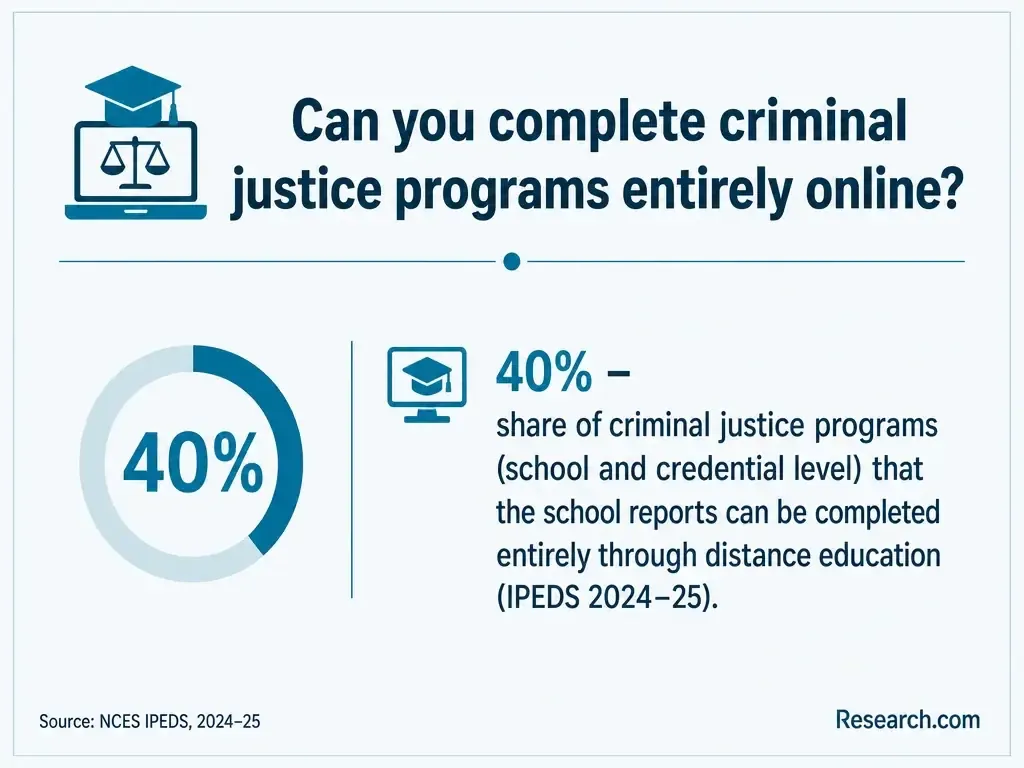
Online courses can make reading, writing, and theory work easier to schedule around a job. On-campus or hybrid study may be more useful when a program requires supervised exercises, field experience, or access to instructors and equipment. A course's online delivery does not establish that every practical requirement can be completed remotely - or that it meets Minnesota POST requirements.
Compare a published course schedule with your commute from Willmar and ask where any in-person activities take place. If flexibility is essential, cheap associate programs online can broaden your comparison, but verify each option's total price, credit transfer, and required in-person work before treating it as equivalent to a local degree.
There is no single reliable Willmar-wide average that describes every student's final bill. Published tuition can vary by enrollment status and term, while the cost of completing a degree depends on credits taken, fees, books, transportation, and living arrangements. Request a current, degree-specific estimate from Ridgewater College for your intended start date; do not treat an earlier published rate as a confirmed 2027 price.
For a useful comparison, ask for tuition and mandatory fees across the full degree, then add textbooks or software, a computer if needed, commuting or field-placement travel, and any required background checks or equipment. Compare that total with the net amount after grants and scholarships. The best and most affordable online colleges may offer alternatives, but a lower advertised rate is not a lower-cost choice if credits do not apply or travel is still required.
Eligible students may be able to use federal grants, loans, and work-study, along with Minnesota state aid, institutional scholarships, or employer tuition assistance. Eligibility depends on the student, institution, enrollment, and program; submitting the FAFSA is the practical first step for federal aid and aid programs that use its information (Federal Student Aid; Minnesota Office of Higher Education).
Compare aid offers by separating grants from loans. A grant reduces the amount you must pay if you meet its conditions; a loan postpones payment and adds a repayment obligation. Ask the financial-aid office how part-time enrollment, changes in course load, and any required fieldwork affect your award before building a budget around it.
College admission and admission to a particular degree pathway are not always the same. Check Ridgewater College's current admission instructions, course placement process, and any program-specific requirements. A field placement or an eventual employer may separately require a background check, driving eligibility, or other screening; do not assume college acceptance clears those conditions.
If your goal is licensed policing, ask the program to identify its relationship to Minnesota POST's current education and licensing process in writing. That question should be resolved before you commit to a degree, because completing general criminal justice coursework does not itself confer a peace-officer license (Minnesota POST Board).
Typical coursework examines criminal law and procedure, policing, courts, corrections, ethics, and report writing, alongside general education such as composition and social science. These subjects build useful skills in clear documentation, interviewing, evidence-aware reasoning, and dealing with people under stress. The actual course list - not the degree's name - shows whether a program addresses your intended job.
Ask for the current degree audit and identify which courses include supervised practice, simulations, or fieldwork. For a transfer-oriented degree, check how general education and major courses will be accepted later; for a career-focused degree, check whether applied courses develop competencies employers request. Ridgewater College's published catalog and an adviser should be the final authorities on its curriculum.
Possible emphases within criminal justice education include law enforcement, corrections, and broader justice-system study, but availability depends on the specific degree and current catalog. Do not assume a concentration exists because a school offers one related course. Ask which courses are required, which are electives, and whether the emphasis changes fieldwork or eligibility for your target role.
If none matches your goal, compare the degree with other associate-level options rather than paying for unrelated electives. You can use a nationally accredited online colleges list to discover providers, but verify each institution's recognized accreditation and each proposed credit-transfer decision directly; accreditation is not a transfer agreement or occupational approval.
Choose the least costly viable route to your particular goal, not simply the school with the lowest tuition or highest ranking. Use the following checks before paying a deposit or registering; each can reveal a cost or eligibility problem that a ranking cannot settle:
A red flag is an assurance that an online or "accredited" degree automatically qualifies you for a Minnesota peace-officer role. Another is a price quote that omits required fees or the time needed to finish. If your priority is speed rather than an associate degree, 6 month certificate programs for high paying jobs offer a different comparison - but check the resulting job eligibility rather than assuming a shorter option serves the same criminal justice goal.
Graduates may seek roles in corrections, security, dispatch, records, or other public-safety support work, subject to each employer's requirements. Licensed policing is a distinct path with additional Minnesota POST conditions. Experience can open opportunities to take on specialized or supervisory responsibilities, but the degree alone does not promise entry or advancement.
To plan realistically, select a few actual Willmar-area postings and compare their requirements with the degree's courses, practical work, and your existing experience. Readers considering education beyond an associate degree can explore what is the easiest masters degree separately; it should not influence whether this associate degree meets an immediate career goal.
The U.S. Bureau of Labor Statistics projects 3.5% national employment growth for police and sheriff's patrol officers from 2025 to 2035. That projection describes one occupation across the United States, not the number of openings in Willmar or prospects for every criminal justice graduate. Local hiring can be intermittent because there are fewer nearby agencies than in a large metropolitan market.
Check recent postings from Willmar, Kandiyohi County, and locations you would realistically commute to or relocate to. Note how often openings appear, whether they require prior experience, and whether they are sworn or civilian positions. That evidence is more useful for a local enrollment decision than applying a national growth rate to the city.
Investing in an education is a consequential decision, especially when a lower advertised tuition price may not mean a lower total cost. Research.com's most-affordable ranking compares programs in the same occupation and location using tuition, cost of attendance, median student debt, and federal loan default rates. Weights are assigned using an entropy-based method, which gives more weight to measures that differ more across programs. Only programs with completions reported to IPEDS are eligible. Accreditation and other quality measures are not part of the affordability score, so readers should check them separately.
The Research.com team uses multiple sources to check the credibility and accuracy of its education data. Some sources below support occupation-specific checks across Research.com rankings rather than the criminal justice affordability score itself:
The ranking is a starting point for finding lower-cost options, not a finding that every listed program meets a particular employer's or Minnesota licensing requirements. Readers can find further details on Research.com's methodology.
# 1 position
# 2 position
It may be if the degree's courses and practical requirements match a job you want and its net total cost fits your budget. Check actual local openings and eligibility requirements before enrolling.
Not automatically. Confirm the current education, training, examination, and licensing requirements with the Minnesota POST Board and ask how the specific program fits that process.
Choose based on the published curriculum and your goal. An AA or AS typically emphasizes transferable coursework; an AAS typically emphasizes applied study. Verify transfer or career-entry claims for the exact degree.
That depends on the program. Ask which courses are remote and whether simulations, fieldwork, or other required activities must be completed in person.
Request a full-degree cost estimate and an aid offer for each eligible option. Include mandatory fees, materials, travel, borrowing, and the time you expect to spend completing required courses.