# 1 position


Audited and Verified:
Our Editorial and Data Verification Process
Research.com uses government datasets, official education statistics and primary institutional information to support its career and degree guides. Our review process checks factual accuracy, occupational definitions, source dates and the requirements associated with the credentials discussed.
How This Article Was Fact-Checked
Our editorial team verifies salary estimates, employment projections, education requirements and program information against original data providers and official organizations. Salary figures are checked against the relevant occupational definitions and reporting periods. Information about licensure, accreditation and required in-person training is reviewed separately.
Fact-checked and verified on:

Co-Founder and Chief Data Scientist

Reviewed by Karolina Broda
Fact-Checker and Data Verification
Choosing an affordable business administration associate degree in Temple means looking beyond tuition: the degree must also fit your schedule, career goal, and plans for further study. The Research.com team of data scientists created the Most Affordable Business Administration Associate Degree Programs in Temple for 2027 ranking to help students identify programs worth considering. The stakes are real: the U.S. Bureau of Labor Statistics projects 5% growth for general and operations managers from 2025 to 2035, although those jobs usually require experience. This guide helps you compare costs, pathways, and realistic outcomes.
Expect a foundation in accounting, economics, management, business communication, and quantitative reasoning, alongside general education. In Temple, the first decision is whether you want coursework built primarily for transfer or a degree emphasizing immediate workplace application. Temple College's current catalog is the source to check for its actual award title, required courses, and availability; a school's general business offerings do not establish that every degree type below is offered.
These common associate degree designs lead to different decisions even when their course titles overlap. Compare the award on the actual degree plan, not just the words "business administration" in a search result.
| Degree design | Primary emphasis | Best fit | Check before enrolling |
| Associate of Arts (AA) | General education and transferable business foundations | Students prioritizing further study | Whether required business and math courses apply to the intended next degree |
| Associate of Science (AS) | General education with potentially more quantitative coursework | Students seeking a transfer-focused route with that course mix | Whether the receiving institution accepts each course as intended |
| Associate of Applied Science (AAS) | Occupation-focused business skills and applied coursework | Students prioritizing near-term employment | Which courses transfer if further study becomes the goal |
Texas public institutions use a statewide core curriculum framework, but course-to-degree application still matters. Ask for a written degree plan and compare it with the requirements of any institution where you might continue studying (Texas Higher Education Coordinating Board).
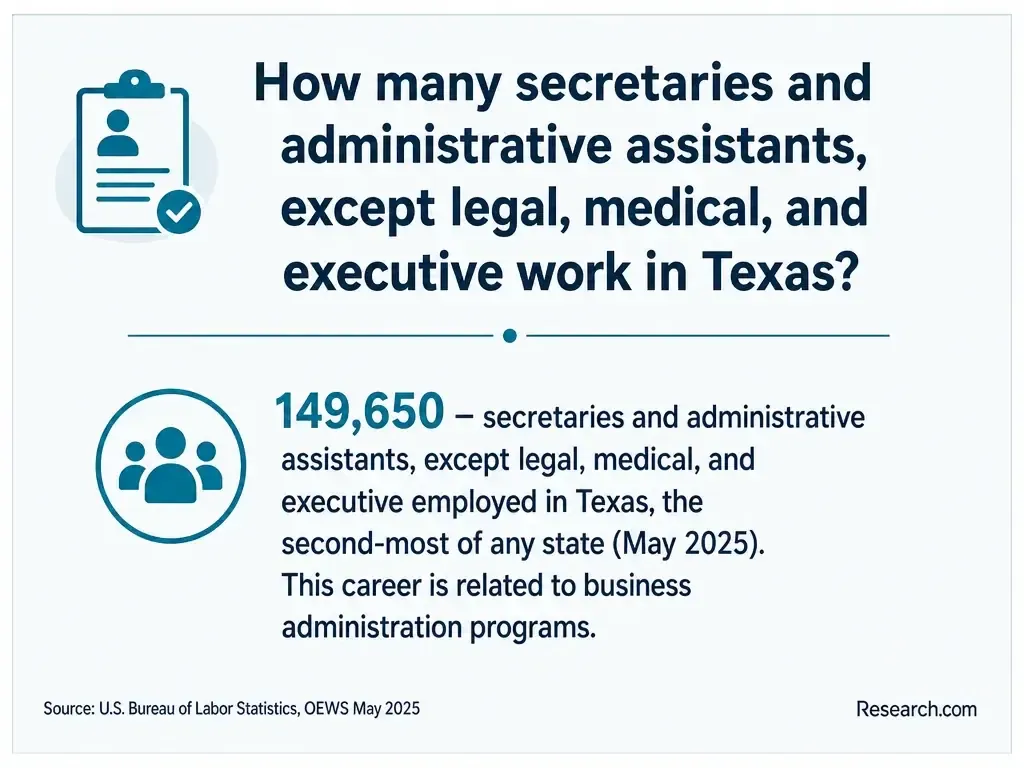
A business administration associate degree can support applications for administrative, customer operations, sales-support, scheduling, purchasing-support, and bookkeeping-related roles. Temple-area healthcare organizations, public offices, retailers, logistics businesses, and other employers all run these functions. The useful question is not whether an industry hires "business graduates," but whether its openings require the software, customer contact, recordkeeping, and schedule that you can offer.
For example, a healthcare employer may have nonclinical scheduling or billing-support work; a logistics employer may need order processing and inventory coordination. These are different from clinical or regulated roles. Review actual Temple-area postings to see whether employers request an associate degree, experience, or specific software before selecting electives or an internship.
There is no single wage for the degree: pay follows the job, employer, experience, and location. The U.S. Bureau of Labor Statistics reports a May 2025 national median of $105,770 for general and operations managers. Many people in that occupation have substantial experience, so this figure is an advancement benchmark - not an expected first paycheck after Temple College (U.S. Bureau of Labor Statistics, Occupational Outlook Handbook).
Before estimating a return on your degree, collect wages from current openings for the specific entry-level roles you would pursue in the Killeen-Temple area. Compare those offers with what you could earn without enrolling. Do not substitute a national manager median for local entry-level pay or assume that holding an associate degree changes your wage automatically.
Plan around the required credits and when courses are offered, not a promise of "two years." A typical Texas associate degree is about 60 semester credit hours, often completed in roughly two academic years with a full-time schedule; part-time study, prerequisite coursework, or courses offered only in certain terms can extend that timeline (Texas Higher Education Coordinating Board). Ask Temple College for a term-by-term plan that matches your work hours.
Acceleration is worthwhile only if the schedule remains manageable. Searches for fast degree programs that pay well can help frame the time-versus-earnings question, but for this degree, check whether summer courses are available, count toward your plan, and preserve eligibility for aid. A faster schedule that leads to withdrawals can cost more than a sustainable one.
Online business courses may let working Temple residents study without a regular campus commute. On-campus sections offer scheduled face-to-face instruction and easier access to some campus services; hybrid courses combine the two. Accounting exercises, discussions, and many written assignments can be delivered online, but a course may still have scheduled exams, presentations, or work-based activities. Check each section's requirements rather than assuming the word "online" means no in-person attendance.
Format does not determine transferability: course equivalency, degree requirements, and the receiving institution's rules do. Searches for accelerated bachelor's degree online texas address a different degree decision; they do not establish whether a Temple College associate course is offered online or will transfer. Business administration itself generally does not require an occupational license, so evaluate online options for learning, access, and transfer fit rather than an assumed licensing shortcut.
There is no defensible Temple-wide average in the information available here, and a 2027 price should not be inferred from an earlier tuition schedule. Temple College's current published tuition and fee schedule is the starting point. Confirm which residency category applies to your address: the rate you qualify for can materially change the cost of the same courses. Then calculate what completing the entire degree is likely to require, including any terms beyond your initial plan.
Tuition is only one part of that calculation. This breakdown helps you request a comparable estimate rather than relying on a single advertised price.
| Cost category | What to include in your estimate |
| College charges | Tuition by applicable residency category, mandatory fees, and any course-specific charges |
| Learning costs | Books, access codes, software, computer, and internet service |
| Attendance costs | Transportation, parking if applicable, and living expenses |
| Time and financing | Work hours forgone, possible extra terms, and borrowing costs |
| Offsets | Grants, scholarships, and employer tuition assistance for which you qualify |
For return on investment, compare the net total with your likely earnings without the degree and plausible earnings afterward. Include completion probability, debt, and how long you expect any earnings difference to last; a low first-semester bill alone cannot answer whether the degree is worth it.
Eligible students may use federal grants, work-study, or loans, subject to program and individual eligibility. The Free Application for Federal Student Aid (FAFSA) establishes eligibility for federal aid and is commonly used in other aid decisions; grants do not generally require repayment, while loans do (Federal Student Aid, U.S. Department of Education). Texas residents should also ask Temple College about state aid, including whether they qualify for the Texas Educational Opportunity Grant, as well as institutional scholarships and payment arrangements (Texas Higher Education Coordinating Board; Temple College).
If you work, ask whether your employer reimburses business coursework and what grades or continued employment it requires. Compare net cost after aid across realistic schedules: changing enrollment intensity may affect aid eligibility and your ability to keep earning while enrolled. Request an individualized aid estimate instead of treating a school-wide average as your award.
Start with Temple College's current admissions and placement instructions. Admission to the college, placement into college-level coursework, and eligibility for a particular degree plan are separate questions. The school may use prior coursework or other measures when advising placement; applicants should confirm how transcripts and any previously earned credits will be evaluated (Temple College).
Before registering, ask which math and writing courses the business plan requires, whether your first-term choices count toward the degree, and how any transfer or prior-learning credit appears on the official plan. A common expensive mistake is taking a convenient course that meets a general requirement but not the intended business pathway.
Business administration associate coursework commonly pairs general education - such as composition, mathematics, and social or behavioral science - with introductory accounting, economics, management, and business applications. The precise mix depends on the award and catalog year. In a transfer-oriented plan, the particular math and accounting sequence can matter as much as the total number of credits; in an applied plan, software and workplace projects may receive more emphasis.
Business skills are practiced through spreadsheets, financial statements, presentations, team assignments, and analysis of routine operating decisions. Ask Temple College whether the degree includes an internship or employer project, whether it is optional or required, and who arranges the placement. Do not assume that two programs with similar titles provide the same practical experience.
Possible areas of emphasis within business associate study include accounting, management, entrepreneurship, and marketing. An emphasis is only useful if its courses serve your intended next step: accounting coursework may suit bookkeeping-related applications, while management projects may better support an employee already moving toward supervisory duties. Confirm which electives or formal emphases Temple College actually offers in your enrollment term rather than assuming every option is available.
Choose by course content and destination, not perceived ease. A search for what's the easiest bachelor degree to get does not tell you which associate-level accounting, math, or communication courses fit your work goals or a future transfer plan. Ask an adviser to identify the courses that would still count if you change direction.
Start with the outcome you need: an entry-level business role, advancement with your current employer, or further study. Then compare Temple College's current degree plan against that outcome. An AA or AS may be preferable when transfer is the priority; an AAS may be a better fit when applied coursework serves an immediate job goal. Neither label guarantees that a particular course will transfer or that an employer will prefer it.
Use this sequence to check the highest-risk assumptions before committing money or time:
Institutional accreditation, transfer agreements, and employer recognition answer different questions; none substitutes for the others. A search for the shortest online masters degree likewise says nothing about the cost or suitability of a Temple business associate degree. Do not let an unrelated ranking - or this affordability ranking alone - replace a documented fit check.
One path is to enter an administrative or operations-support role, build proficiency with records, scheduling, spreadsheets, and customers, and then compete for greater responsibility. Another is to use transfer-oriented associate coursework as the foundation for further study. Existing employees may find the degree most valuable when its accounting or management courses address a specific promotion requirement; graduates without work experience should expect to demonstrate skills in entry-level applications first.
Working style also matters. Someone considering best jobs for introvert might prefer records-heavy or accounting-support work over a sales-facing position, but every business role still requires communication. Optional software or bookkeeping certifications may strengthen a particular application; there is no general Texas occupational license for working in business administration, and an associate degree does not itself confer a professional license.
The national outlook for general and operations managers is 5% employment growth from 2025 to 2035, according to the U.S. Bureau of Labor Statistics Employment Projections. That indicates continuing demand for management work nationally, but it does not measure Temple openings for new associate degree holders. Management positions often require experience, and different entry-level office or operations occupations can have different outlooks.
For a local decision, review recent Killeen-Temple-area vacancies by job title, not by degree name. Note the education requested, experience threshold, software requirements, shift, and posted pay. If openings you can realistically pursue rarely request an associate degree, consider whether the degree's transferable coursework or your current employer's advancement rules justify its net cost before enrolling.
Investing in education is an important decision, so Research.com designed its ranking to make local cost comparisons more transparent. Programs are compared with others in the same field and location; only programs with completions reported to the Integrated Postsecondary Education Data System (IPEDS) are eligible. That eligibility rule should not be mistaken for a judgment about providers absent from IPEDS.
The most-affordable ranking scores costs and debt only: tuition, cost of attendance, median student debt, and federal loan default rate. Indicator weights are assigned using an entropy-based method, which gives more weight to measures that differ more across eligible programs. Accreditation and other quality measures are not part of this affordability score. Research.com's separate best-programs methodology considers student outcomes, earnings and return on investment, costs and debt, and quality and recognition. Its current weights assign 20% to relevant programmatic accreditation or industry recognition, 10% to institutional accreditation, 10% to student support, and the remaining 60% across outcomes, earnings, and costs using the entropy-based method.
The research team uses the following databases and reference organizations in its ranking work. Several occupation-specific organizations below concern other fields; listing them does not imply that allied-health, dental, or construction approvals apply to business administration.
Use the ranking to narrow your cost comparison, then check the current program catalog, transfer rules, and your likely aid package before enrolling. More detail about the ranking approach appears in Research.com's methodology.
# 1 position
# 2 position
It can be if its courses support a job you can pursue, advancement at work, or a documented transfer plan. Compare your net degree cost and time away from work with realistic outcomes; a manager's median wage is not a graduate earnings estimate.
Consider a transfer-oriented AA or AS if course application at your intended next institution is the priority. Consider an AAS if its applied courses better match your immediate work goal. Verify Temple College's current awards and degree plans before deciding.
That depends on which required courses Temple College offers in your terms and whether individual sections have in-person requirements. Request a complete course-by-course plan rather than relying on the format of one class.
Business administration is not a generally licensed occupation in Texas. Particular jobs may have separate employer, certification, or regulatory requirements; check those requirements for the role you want.
Ask for your estimated full-degree net cost using your actual residency category, planned course load, mandatory fees, books, likely aid, and commuting expenses. A tuition-only quote is not enough to compare affordability.