# 1 position

Audited and Verified:
Our Editorial and Data Verification Process
Research.com uses government datasets, official education statistics and primary institutional information to support its career and degree guides. Our review process checks factual accuracy, occupational definitions, source dates and the requirements associated with the credentials discussed.
How This Article Was Fact-Checked
Our editorial team verifies salary estimates, employment projections, education requirements and program information against original data providers and official organizations. Salary figures are checked against the relevant occupational definitions and reporting periods. Information about licensure, accreditation and required in-person training is reviewed separately.
Fact-checked and verified on:

Co-Founder and Chief Data Scientist

Reviewed by Karolina Broda
Fact-Checker and Data Verification
Choosing a criminal justice associate degree in San Jacinto means deciding whether the coursework will help you enter a justice-related job, prepare for a later career move, or both. The U.S. Bureau of Labor Statistics reports a $76,210 national median annual wage for police and sheriff's patrol officers in May 2025 - but that is not a new graduate's expected salary. This guide explains costs, degree types, hiring requirements, and career trade-offs alongside the Best Criminal Justice Associate Degree Programs in San Jacinto for 2027 ranking, created by the Research.com team of data scientists to help students make informed choices.
A criminal justice associate degree studies how policing, courts, corrections, and the law interact. At Mt San Jacinto Community College District, begin by checking the current catalog for the exact degree title, required courses, and campus or online availability; similar-sounding programs can have different graduation requirements. Coursework may develop report writing, evidence evaluation, communication, and an understanding of constitutional limits on government action.
The degree award matters more than the label "criminal justice" alone. This comparison shows what to verify before choosing a course plan:
| Associate degree pathway | Typical emphasis | Best fit | Key check |
| Transfer-oriented AA or AS | General education and courses intended to continue into further study | Students who want to preserve future academic options | Which required courses will transfer under a documented agreement? |
| Career-focused AS or AAS, if offered | Occupation-related coursework and applied skills | Students prioritizing near-term workplace preparation | Which credits transfer, and is practical experience included? |
Degree titles and availability must be confirmed with the college; this table does not assert that every listed award is offered locally. An associate degree is not a police academy, a hiring offer, or occupational licensure.
Potential settings include local law enforcement agencies, county courts, correctional facilities, security operations, and administrative offices that handle records or public contact. The Riverside County Sheriff's Department provides policing services in San Jacinto, making county hiring rules particularly relevant to a student interested in local patrol work (Riverside County Sheriff's Department). A justice-related degree may also support applications for records or support roles, but each posting controls eligibility.
Match the program to the employer, not just the industry. A court-support applicant should emphasize document accuracy and confidentiality; a patrol applicant should examine agency selection standards and physical requirements. California's Commission on Peace Officer Standards and Training, or POST, sets standards relevant to peace-officer hiring and preparation. An associate degree alone does not satisfy every selection, academy, or employer requirement (California POST).
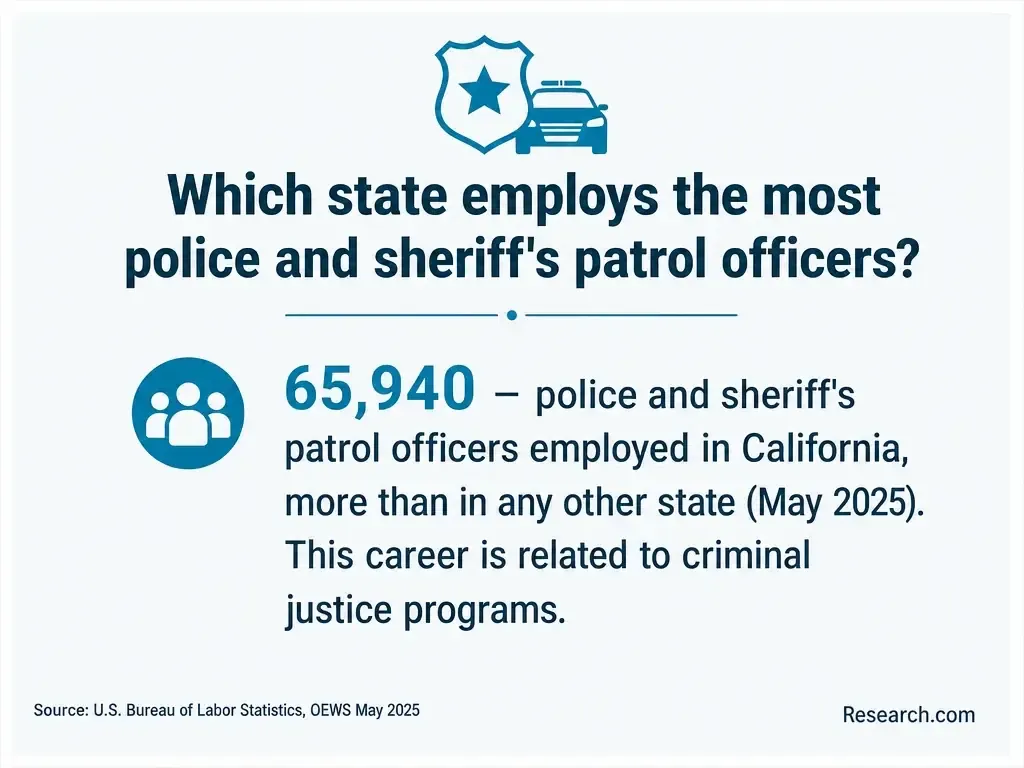
The national median annual wage for police and sheriff's patrol officers was $76,210 in May 2025 (U.S. Bureau of Labor Statistics, Occupational Outlook Handbook). That occupation is one possible destination, not a salary attributable to an associate degree. The figure includes workers at different career stages and locations; an entry-level offer in Riverside County may differ because of agency pay schedules, shift assignments, and experience.
For a useful return-on-investment comparison, obtain the pay range for the specific jobs you could apply for, then weigh likely earnings against total degree cost, aid, possible debt, time out of work, and your probability of completing. Compare outcomes over several years rather than treating a median as immediate pay. Rankings of masters programs that make the most money describe a different career stage and are not a sound benchmark for an associate-degree starting salary.
Plan around the college's published credit requirements and course sequence, not a promised finish date. A full-time associate degree is commonly planned across two academic years, while part-time enrollment takes longer; required general education, course availability, placement, and accepted prior credits all affect the schedule. Confirm the current Mt San Jacinto Community College District degree audit before estimating your own completion date (Mt San Jacinto Community College District catalog).
If you work rotating shifts, a lighter course load may protect your grades and income even if it extends the calendar. Ask whether essential criminal justice courses are offered in the term and format you need; a fast general-education schedule is less helpful if one required major course delays graduation. Advice about best accelerated adult degree programs online can prompt useful scheduling questions, but only the local degree plan establishes how quickly you can finish.
Online courses can make reading, discussions, and written assignments easier to fit around work. Campus classes may offer more direct access to instructors, classmates, and local career contacts. Either format can teach law and justice-system fundamentals; neither automatically provides practical experience or meets an agency's hiring standards.
Ask which required courses are online, whether exams have set meeting times, and whether any internship, observation, or other applied requirement must occur in person. Also confirm whether the college helps students arrange local placements. When comparing online cheap colleges, check the actual associate degree's accreditation, fees, credit-transfer treatment, and any travel requirement - not just its advertised tuition. California POST and the hiring agency, rather than an online-course label, determine relevant peace-officer requirements (California POST).
There is no dependable single "average" that tells a San Jacinto student what completing this particular degree will cost. Published tuition may depend on California residency and current college charges, while the student's schedule and commute affect the final bill. Use the current Mt San Jacinto Community College District fee schedule and cost-of-attendance estimate for a personalized comparison, rather than treating tuition as the total price (Mt San Jacinto Community College District).
The following cost categories help distinguish a low per-course price from a lower cost to finish:
| Cost category | What to check | Why it changes the decision |
| College charges | Enrollment tuition and mandatory fees under your residency status | Published rates may not reflect your full course load or status |
| Course materials | Books, software, and required technology | Online and campus sections may have different material costs |
| Attendance | Transportation, parking, and living expenses | Travel or reduced work hours can exceed a tuition difference |
| Career entry | Any employer-required screening, equipment, or later application expenses | The degree price is not necessarily the full cost of pursuing a job |
Subtract grants, scholarships, and employer assistance when comparing what you would actually pay. If costs make a full-time schedule unrealistic, part-time study may reduce immediate pressure but increase the time before completion.
Eligible students can apply for federal aid using the Free Application for Federal Student Aid, or FAFSA. California residents should also check California College Promise Grant eligibility and other state aid administered through the college. Eligibility depends on the student, institution, enrollment, and current program rules; an award is not automatic (Federal Student Aid; California Community Colleges Chancellor's Office).
Compare the aid offer with your entire attendance budget, especially if work hours must fall during a required course. Ask the financial aid office whether part-time attendance changes your award and whether employer tuition assistance can cover remaining charges. An older student considering an associate degree can ask the same eligibility questions; age alone should not be used to rule out options discussed in top degrees for 60 year olds (Federal Student Aid).
Separate college admission from degree completion and job eligibility. Confirm Mt San Jacinto Community College District's current application, placement, residency documentation, and any course prerequisites before registering. Then check the catalog's general-education and major requirements. Admission to the college does not mean every course is immediately available or that graduation requirements have been met (Mt San Jacinto Community College District).
For prospective peace officers, separately review California POST standards and the intended agency's recruitment notice. Background investigation and other selection requirements concern employment, not admission to a criminal justice associate degree. Checking those rules early can prevent spending on a degree under the mistaken belief that graduation itself qualifies you for appointment (California POST).
Expect a combination of general education - such as writing, quantitative reasoning, and social science - and major coursework on criminal law, courts, policing, corrections, or criminal procedure. Exact titles, electives, and credit requirements depend on the published local degree plan (Mt San Jacinto Community College District catalog). Writing and careful reading matter because justice work often involves reports, records, policy, and decisions with legal consequences.
Compare course descriptions rather than assuming similarly named degrees build identical skills. Someone interested in investigations should look for evidence, procedure, and analytical writing; someone interested in court operations should check for court-focused content and document practices. Ask whether any practical learning is required, optional, or unavailable, and what students actually do during it. Classroom study should not be mistaken for academy instruction or supervised field experience.
An associate degree may let students emphasize interests through electives even when the college does not offer a formally named specialization. Common subject areas include policing, corrections, courts, and criminal law; verify which choices appear in the current Mt San Jacinto Community College District catalog rather than assuming every option is available each term.
Choose electives for a concrete purpose. Police-focused courses can build context for agency applications, while courts- or records-focused study may better match support work. Before using an elective slot, check whether it satisfies your degree plan and, if relevant, an agreed transfer requirement. A course emphasis does not confer an occupational license, special hiring status, or certification.
The best choice is the associate degree you can complete affordably that also fits your intended job or academic next step. A ranking can identify programs to investigate, but it cannot determine your residency charges, shift schedule, transfer-credit needs, or eligibility for a particular agency. Ask the college and prospective employers for answers before committing.
Use this sequence to test whether a program fits your goal:
A common mistake is choosing the cheapest advertised tuition while overlooking a course that rarely fits your schedule. Another is assuming a degree with "criminal justice" in its title qualifies you for patrol work. If immediate earnings are the priority, compare actual local entry-level job requirements with degree costs; lists of high paying trade school jobs are not evidence that this associate degree leads to those wages.
Possible paths include applying for law-enforcement positions, seeking court or agency support work, pursuing correctional or security-related roles, and using the associate degree for further academic study. Access differs by role: an agency can require its own selection process and preparation, while a support position may value writing, records management, and public-facing experience. Check each Riverside County or other local posting rather than treating these paths as automatic graduate outcomes.
Progression also depends on performance and employer rules. An employee may move from support duties into more specialized work or supervision with experience and additional requirements; a student may instead choose courses that keep transfer options open. Request examples of recent, verifiable program outcomes from the college, and ask whether they describe graduates of your exact associate degree rather than all justice-related students.
The U.S. Bureau of Labor Statistics projects 3.5% growth in employment for police and sheriff's patrol officers nationally from 2025 to 2035. This is an occupational projection, not a forecast of vacancies in San Jacinto or of hiring specifically for associate degree graduates. Agency budgets, retirements, selection standards, and recruitment cycles determine when local openings arise (U.S. Bureau of Labor Statistics, Employment Projections).
San Jacinto applicants should compare opportunities across the commutable Riverside County area and read current postings for education, schedules, tests, and background standards. That matters because a local degree can be useful even when a preferred agency is not hiring immediately - but only if its courses also support other roles or your next academic step. Keep expectations flexible and evaluate an actual offer against commuting costs and starting pay, not the national occupational median.
Investing in an associate degree is a consequential decision. Research.com created its ranking to help readers compare programs against relevant local options, rather than assume that a recognizable school name or low advertised tuition is enough. Programs are considered only when completions are reported to the Integrated Postsecondary Education Data System (IPEDS); this eligibility rule does not mean that other providers are unapproved or poor quality.
The best-programs methodology considers student outcomes, earnings and return on investment, costs and debt, and quality and recognition. Program-relevant accreditation or industry recognition accounts for 20% of the score, institutional accreditation for 10%, and student support services for 10%. The remaining 60% covers completion and retention, earnings after completion, earnings relative to annual attendance cost, tuition, attendance cost, debt - including debt among students who withdrew - and federal loan default rates. An entropy-based method distributes that remaining weight according to how much indicators differ across programs. Occupational recognition used for other rankings is not automatically relevant to criminal justice.
The Research.com team uses the following sources across its program-ranking work. Their inclusion here does not imply that every accreditor or industry organization evaluates criminal justice associate degrees:
Readers can use the ranking to build a shortlist, then confirm current program requirements and costs directly with the college. Research.com explains its broader approach on its methodology page. A separate most-affordable-programs ranking, if consulted, scores only tuition, attendance cost, debt, and loan default rates; its entropy-weighted score does not include accreditation or other quality indicators.
# 1 position
# 2 position
Not universally. Check California POST standards and the specific agency's posting. An associate degree may help you prepare, but it does not replace selection, background, or required peace-officer preparation (California POST).
Choose a transfer-oriented plan if preserving documented credit-transfer options is your priority. Consider a career-focused plan if its applied courses better fit your target job. Confirm the exact award and requirements in the current college catalog.
That depends on the college's current course schedule and any practical requirements. Confirm whether every required course is available online and whether exams, internships, or other activities require attendance. Online graduation does not establish eligibility for a particular job.
Ask the college for charges based on your residency and planned course load. Add books, technology, transportation, and living costs, then subtract aid you are awarded - not aid you merely expect.
No. Verify institutional accreditation, then separately confirm course transfer with the receiving institution and job eligibility with the employer. These are different decisions with different rules.