# 1 position


Audited and Verified:
Our Editorial and Data Verification Process
Research.com uses government datasets, official education statistics and primary institutional information to support its career and degree guides. Our review process checks factual accuracy, occupational definitions, source dates and the requirements associated with the credentials discussed.
How This Article Was Fact-Checked
Our editorial team verifies salary estimates, employment projections, education requirements and program information against original data providers and official organizations. Salary figures are checked against the relevant occupational definitions and reporting periods. Information about licensure, accreditation and required in-person training is reviewed separately.
Fact-checked and verified on:

Co-Founder and Chief Data Scientist

Reviewed by Karolina Broda
Fact-Checker and Data Verification
Choosing the cheapest criminal justice associate degree in Hawaii means looking beyond tuition: travel between islands, fees, and career requirements can change the value of a program. The national median annual pay for police and sheriff's patrol officers was $76,210 in May 2025, but that is not a starting salary or a promise of employment (U.S. Bureau of Labor Statistics). This guide explains costs, degree pathways, and career trade-offs. It also features the Most Affordable Criminal Justice Associate Degree Programs in Hawaii for 2027 ranking, created by the Research.com team of data scientists to help students identify programs worth considering.
A criminal justice associate degree combines general education with study of policing, courts, corrections, and the rules governing each. In Hawaii, compare the exact degree title and curriculum rather than assuming similarly named programs lead to the same outcome. Honolulu Community College, Hawaii Community College, and University of Hawaii Maui College are useful starting points for checking current administration-of-justice offerings; confirm the award, catalog requirements, and available courses directly with each college.
An Associate of Arts (AA) generally emphasizes broadly transferable coursework. An Associate of Science (AS) may combine general education with more occupation-focused study. The degree label alone does not establish transferability or hiring eligibility: a student seeking employment should examine practical coursework, while a student planning further study should request a course-by-course transfer review. Skills worth looking for include report writing, ethical reasoning, interviewing, evidence handling, and clear communication under pressure.
Graduates may pursue entry-level work with public safety agencies, correctional facilities, court systems, security employers, or organizations that support crime prevention and victim services. Openings and qualifications differ by employer and island. A program located near a prospective employer may make field visits and interviews easier, while a less expensive distant program can become costly if participation requires repeated travel.
An associate degree is not a police appointment. Hawaii law enforcement agencies set their own recruitment and screening requirements, which can include examinations, background investigations, fitness standards, and agency instruction. Ask an employer whether the degree improves eligibility, competitiveness, or pay before treating it as a required route into a specific job.
The U.S. Bureau of Labor Statistics reports a $76,210 national median annual wage for police and sheriff's patrol officers in May 2025. That figure covers employed officers across experience levels; it is not the expected wage for a new associate degree graduate. Security, corrections, and administrative roles have different pay scales, so use the occupation and employer you actually intend to enter when estimating returns.
Compare a posted Hawaii starting-pay range with the cost of finishing your degree, any debt, earnings forgone while studying, and your likelihood of completing the program. If your main goal is earnings rather than a particular justice occupation, compare the employment prospects of different college majors before committing.
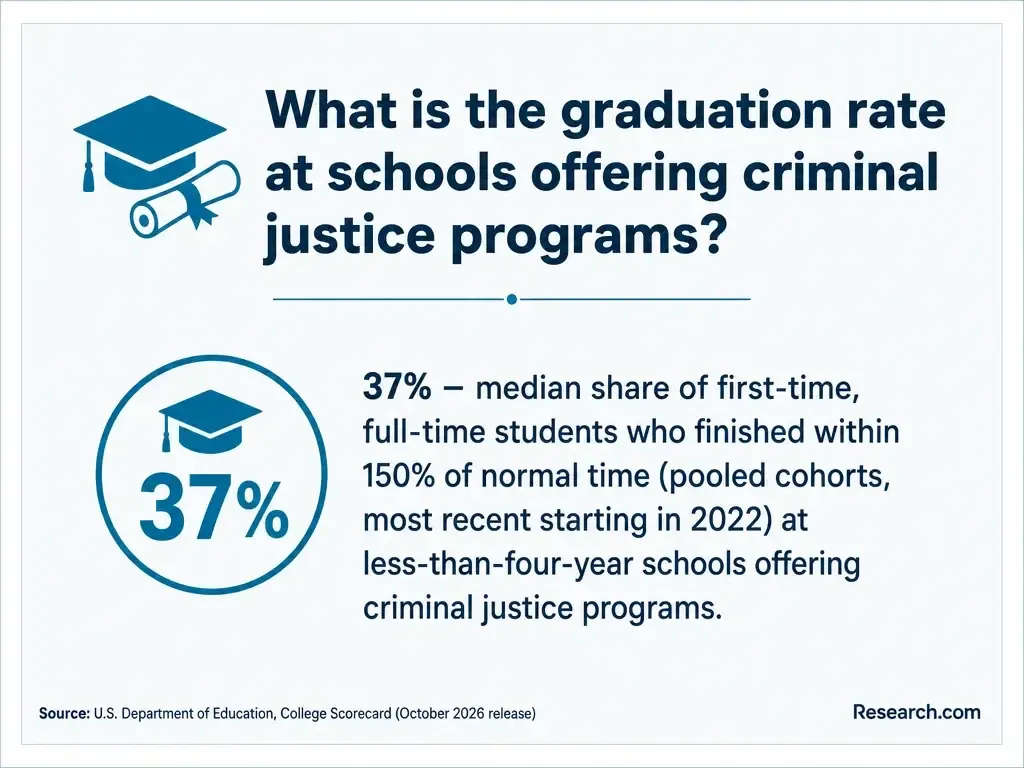
Many associate degree pathways are designed around approximately 60 credits, commonly completed in about two academic years of full-time study. Actual credit requirements, course rotations, and time to completion depend on the college and the number of credits a student can take each term. Part-time study can preserve income but extend the period over which fees and living costs accumulate.
Before choosing an accelerated schedule, ask when required criminal justice courses are offered and whether prerequisites or fieldwork limit how quickly you can finish. Transferred credits or approved prior learning may shorten the route, but only if the receiving college applies them to degree requirements. For a broader comparison of scheduling options, see the quickest ways to earn an associate degree.
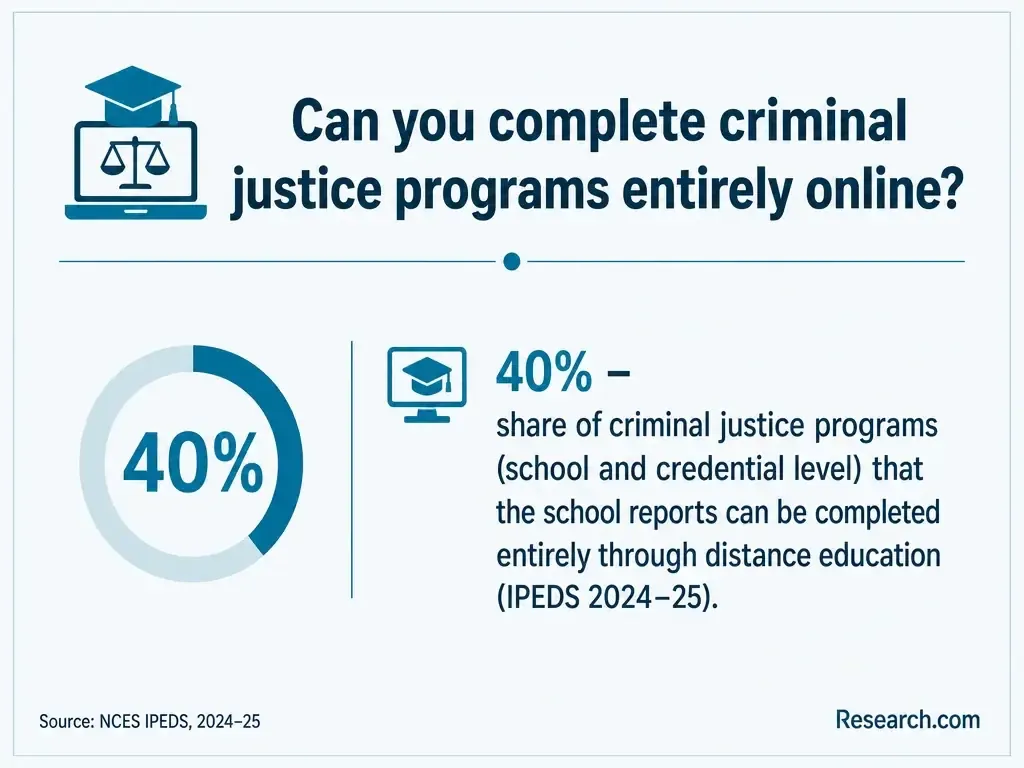
Online coursework can reduce commuting for students outside a campus's immediate area, particularly when classes focus on law, ethics, writing, or criminal justice systems. It does not remove the need to check scheduled exams, campus meetings, or any required field experience. A hybrid program may offer flexibility while retaining in-person activities; an on-campus program may make it easier to build local employer connections.
For an interisland student, the decisive question is not whether a program is advertised as "online," but whether every required course and activity can be completed from the student's location. Request a term-by-term schedule and ask who arranges any local placement. Working adults can also compare scheduling considerations in guides to online degrees for older adults, while confirming the details of the specific criminal justice associate degree.
There is no single reliable price for a criminal justice associate degree in Hawaii. The amount depends on residency classification, credits required, course load, fees, aid, and whether a student must travel or relocate. Published annual tuition is particularly easy to misread when a student attends part time or needs an extra term to complete a required course.
To compare offers fairly, request an itemized estimate through graduation. Include tuition, mandatory and course fees, books or software, a suitable device and internet access, transportation, living expenses, and any costs of employer-required screening or applications. Subtract grants and scholarships you are likely to receive, but keep loans in the total: borrowing changes when you pay, not what the degree costs. The lowest sticker price may not be the lowest completed-degree cost.
Eligible students can explore federal grants, federal student loans, institutional scholarships, employer tuition assistance, and Hawaii-based aid. Federal Student Aid explains that eligibility depends on factors including the student, institution, and program; completing the FAFSA is the practical first step for federal aid consideration. Ask each financial aid office which awards apply to your enrollment intensity and whether any require annual renewal.
Do not assume an online option is aid-eligible simply because its parent institution offers aid. Confirm the specific program and your circumstances with the school; this guide to online schools that accept FAFSA can help frame that conversation. For a working student, employer assistance may offset costs but may also require continued employment or reimbursement after successful course completion.
Admissions requirements vary by college, but applicants should expect to provide educational records and complete any placement or advising steps the institution requires. Prior college work may affect placement or transfer credit. Ask whether admission to the college automatically permits enrollment in every required criminal justice course and whether courses have prerequisites or limited seats.
School admission and job eligibility are separate decisions. A person can qualify for an associate degree program yet not meet a particular agency's hiring standards. If you have a specific employer in mind, review its current requirements - including any background, physical, or driving standards - before paying for coursework solely to pursue that position.
Course plans commonly pair composition, mathematics, and other general education with introductions to criminal justice, criminal law, policing, courts, and corrections. Electives may address juvenile justice, criminology, or investigative methods. Compare required courses, not just catalog descriptions: writing-intensive work is especially relevant to reports and testimony, while law and ethics courses help students assess decisions made under legal constraints.
If a program advertises an internship or other work-based learning, ask whether it is required, how many hours it involves, who secures placements, and whether placements are available on your island. Do not treat an optional field opportunity as equivalent to supervised experience built into the degree.
At the associate level, specialization may be a small group of electives rather than a formally named concentration. Depending on the college's current catalog, students may be able to emphasize policing, corrections, court processes, or community-focused topics. Course availability matters as much as the topic: an elective that is rarely offered may delay graduation.
Choose electives backward from your objective. A prospective law enforcement applicant might prioritize writing, criminal procedure, and community relations; someone interested in court support might favor legal processes and records-related coursework. Ask an adviser whether the chosen courses satisfy degree requirements and remain useful if your career plans change.
The best-value program is the one you can afford to complete and use for your intended next step. Research.com's affordability ranking can narrow the cost search, but its score does not assess whether a program's courses, location, or schedule fit you. A low-cost option is a poor investment if unavailable required courses prolong enrollment or if its coursework does not serve your goal.
Use these checks before accepting an offer:
A common mistake is treating accreditation, transfer acceptance, and hiring approval as interchangeable. They answer different questions. Another is using an experienced worker's median wage as a new graduate's expected pay. Evaluate returns over a realistic time horizon, accounting for aid, debt, completion probability, lost earnings, and the pay available to you without the degree.
An associate degree can support applications for roles in policing, corrections, security, court operations, or related administrative work, depending on the employer's rules. Some students use it to build broadly useful skills before seeking further education. Neither route is automatic: hiring may require separate screening and instruction, and future study depends on the receiving institution's credit decisions.
Direct entry to an employer may make more sense if a desired job does not require a degree and provides its own instruction. The associate degree may be more useful if you want structured study of justice systems, an additional qualification for eligible openings, or a transferable academic foundation. If your interests are more hands-on and outside criminal justice, compare the costs and job requirements of trade career paths that pay well rather than assuming one route has better returns.
The U.S. Bureau of Labor Statistics projects 3.5% national employment growth for police and sheriff's patrol officers from 2025 to 2035. This is an occupational projection, not a forecast of associate degree graduate placements or openings on a particular Hawaiian island. Local hiring also depends on agency budgets, vacancies, and applicants' eligibility.
Check current postings for the island where you can work, then compare their stated education requirements, pay ranges, and selection steps. The Hawaii Department of Labor and Industrial Relations is a source for state labor-market information, but a statewide figure may hide limited options near home. Students who cannot relocate should give local employer access and any travel requirements substantial weight when comparing otherwise similar programs.
Investing in an associate degree is an important decision, so Research.com designed its affordability ranking to help readers compare programs against relevant local options - not against unrelated schools nationwide. Only programs with completions reported to IPEDS are eligible. The most affordable ranking scores tuition, cost of attendance, median student debt, and federal loan default rate; an entropy-based method gives more weight to measures that vary more across eligible programs. Accreditation and other quality indicators do not contribute to this affordability score, so readers should check them separately.
The Research.com team uses the following data sources in its ranking work. Some sources cover other occupations and should not be interpreted as criminal justice program accreditors or requirements:
The ranking is a starting point for a cost comparison, not a finding that every listed program fits every career goal. Readers can learn more about the approach on the Research.com methodology page.
# 1 position
# 2 position

# 3 position

# 4 position

# 5 position

Do not assume so. Check the current requirements of the specific hiring agency; its selection process and instruction are separate from college admission and graduation.
Neither is universally better. Compare required courses and obtain a written transfer evaluation if future study is your goal; compare occupation-relevant coursework and employer requirements if immediate work is your priority.
Possibly, but verify every required course, exam, and field activity with the college. "Online" does not by itself establish that no travel will be necessary.
Plan around the college's published credit requirements and course schedule. Approximately two academic years is a common full-time planning estimate, not a guaranteed completion date.
Not by itself. Use it to compare costs and debt, then check curriculum, schedule, accreditation, total personal cost, and fit with your intended employer or next educational step.